
|
You entered: dark
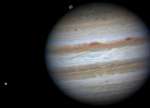 Jupiter Near Opposition
22.10.2011
On October 29 (UT), Jupiter, the solar system's largest planet, will be at opposition, opposite the Sun in planet Earth's sky, shining brightly and rising as the Sun sets. That configuration results...
 Noctilucent Clouds over London
10.07.2014
This scene from the early morning hours of July 3 looks out across the River Thames from the Westminster Bridge. Part of a luminous timelapse video (vimeo), the frame captures a sight familiar in London, the nighttime glow of the London Eye.
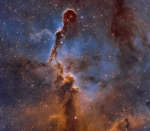 The Elephant s Trunk Nebula in Cepheus
16.08.2019
Like an illustration in a galactic Just So Story, the Elephant's Trunk Nebula winds through the emission nebula and young star cluster complex IC 1396, in the high and far off constellation of Cepheus. Also known as vdB 142, the cosmic elephant's trunk is over 20 light-years long.
 APOD: 2023 October 29 Б A Partial Lunar Eclipse
29.10.2023
What's happened to the Moon? Within the last day, part of the Moon moved through the Earth's shadow. This happens about once or twice a year, but not every month since the Moon's orbit around the Earth is slightly tilted.
 Titan: Moon over Saturn
3.05.2025
Like Earth's moon, Saturn's largest moon Titan is locked in synchronous rotation with its planet. This mosaic of images recorded by the Cassini spacecraft in May of 2012 shows its anti-Saturn side, the side always facing away from the ringed gas giant.
 APOD: 2026 March 19 Б Launch Plume: SpaceX Jellyfish
19.03.2026
Even if you live with your head in the clouds, you wonБt find a jellyfish like this one very often. The featured image shows a SpaceX Falcon 9 rocket launch from Cape Canaveral in Florida on March 4.
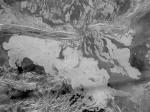 Lava Flows on Venus
23.03.2004
The hot surface of Venus shows clear signs of ancient lava flows. Evidence of this was bolstered by the robot spacecraft Magellan, which orbited Venus in the early 1990s. Using imaging radar, Magellan was able to peer beneath the thick perpetual clouds that cover Earth's closest planetary neighbor.
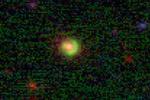 Ring Around the Galaxy
23.12.1998
It is difficult to hide one galaxy far behind another. The closer galaxy's gravity will act like a huge lens, pulling images of the background galaxy around both sides. This is just...
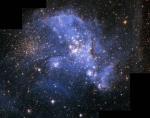 NGC 346 in the Small Magellanic Cloud
18.01.2005
A satellite galaxy of the Milky Way, the Small Magellanic Cloud (SMC) is a wonder of the southern sky, a mere 210,000 light-years distant in the constellation Tucana. Found among the SMC's clusters and nebulae NGC 346 is a star forming region about 200 light-years across, pictured above by the Hubble Space Telescope.
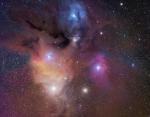 The Colorful Clouds of Rho Ophiuchi
14.07.2006
This stunning mosiac of the sky around bright stars Antares (Alpha Scorpii) and Rho Ophiuchi reveals spectacular colors in a cosmic starscape. Near the top, Rho Ophiuchi and nearby stars are immersed in blue reflection nebulae - dust clouds that shine primarily by reflected starlight.
|
January February March April May June July August September |
|||||||||||||||||||||||||||||||||||||||||||||||||