
|
You entered: dark
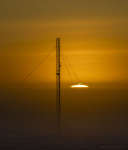 Sunrise at the South Pole
5.10.2021
Sunrise at the South Pole is different. Usually a welcome sight, it follows months of darkness -- and begins months of sunshine. At Earth's poles, it can take weeks for the Sun to rise, in contrast with just minutes at any mid-latitude location.
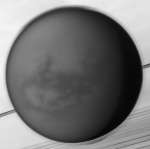 Titan: Moon over Saturn
27.05.2022
Like Earth's moon, Saturn's largest moon Titan is locked in synchronous rotation. This mosaic of images recorded by the Cassini spacecraft in May of 2012 shows its anti-Saturn side, the side always facing away from the ringed gas giant.
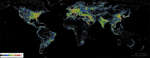 APOD: 2023 March 8 Б Artificial Night Sky Brightness
8.03.2023
Where have all the dim stars gone? From many places on the Earth including major cities, the night sky has been reduced from a fascinating display of thousands of stars to a diffuse glow through which only a few stars are visible.
 APOD: 2024 September 17 Б Melotte 15 in the Heart Nebula
17.09.2024
Cosmic clouds form fantastic shapes in the central regions of emission nebula IC 1805. The clouds are sculpted by stellar winds and radiation from massive hot stars in the nebula's newborn star cluster, Melotte 15.
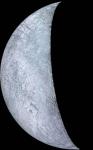 Crescent Europa
25.02.2002
Although the phase of this moon might appear familiar, the moon itself might not. In fact, this crescent shows part of Jupiter's moon Europa. The passing robot spacecraft Voyager 2 captured this image in 1979.
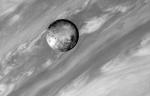 5 Million Miles From Io
11.03.1999
Twenty years ago this month, NASA's Voyager 1 spacecraft flew past Jupiter and its moons. This sharp picture of moon Io against a background of gas giant Jupiter's diffuse swirling cloud bands was recorded by Voyager's camera from a distance of about 5 million miles.
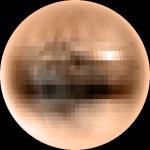 Pluto in True Color
3.09.2006
Pluto is mostly brown. The above picture captures the true colors of Pluto as well as the highest surface resolution so far recovered. Although no spacecraft has yet visited this distant world, the New Horizons spacecraft launched early this year is expected to reach Pluto in 2015.
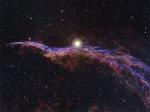 NGC 6960: The Witch's Broom Nebula
1.01.2007
Ten thousand years ago, before the dawn of recorded human history, a new light must suddenly have appeared in the night sky and faded after a few weeks. Today we know this light was an exploding star and record the colorful expanding cloud as the Veil Nebula.
 A Total Solar Eclipse Over China
5.08.2008
What's that black dot over the Sun? The Moon. This past weekend, the Sun went dark during the day as the Moon completely covered it. The total solar eclipse was visible over a thin swath of Earth extending from northern Canada to China.
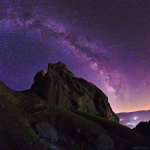 The Starry Night of Alamut
25.06.2010
A meteor's streak and the arc of the Milky Way hang over the imposing mountain fortress of Alamut in this starry scene. Found in the central Alborz Mountains of Iran, Alamut Castle was built into the rock in the 9th century. The name means Eagle's Nest.
|
January February March April May June July August September |
|||||||||||||||||||||||||||||||||||||||||||||||||