
|
You entered: dark
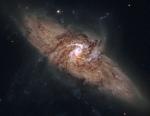 NGC 3314: When Galaxies Overlap
11.05.2000
Can this be a spiral galaxy? In fact, NGC 3314 consists of two large spiral galaxies which just happen to almost exactly line-up. The foreground spiral is viewed nearly face-on, its pinwheel shape defined by young bright star clusters.
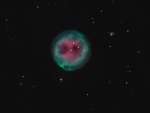 M97: The Owl Nebula
15.05.2009
The Owl Nebula is perched in the sky about 2,600 light-years away toward the bottom of the Big Dipper's bowl. Also cataloged as M97, the 97th object in Messier's well-known list, its round shape along with the placement of two large, dark "eyes" do suggest the face of a staring owl.
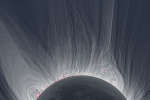 Detailed View of a Solar Eclipse Corona
16.03.2010
Only in the fleeting darkness of a total solar eclipse is the light of the solar corona easily visible. Normally overwhelmed by the bright solar disk, the expansive corona, the sun's outer atmosphere, is an alluring sight.
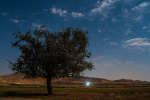 Perseid in Moonlight
15.08.2014
Bright moonlight from a Full Moon near perigee illuminates the night and casts shadows in this skyscape from central Iran. Taken on August 12, near the peak of the annual Perseid meteor shower the exposure also captures a bright and colorful perseid streak above the shady tree in the foreground.
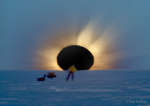 A Total Eclipse at the End of the World
14.03.2015
Would you go to the end of the world to see a total eclipse of the Sun? If you did, would you be surprised to find someone else there already? In 2003, the Sun, the Moon, Antarctica, and two photographers all lined up in Antarctica during an unusual total solar eclipse.
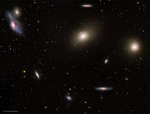 In the Heart of the Virgo Cluster
7.04.2015
The Virgo Cluster of Galaxies is the closest cluster of galaxies to our Milky Way Galaxy. The Virgo Cluster is so close that it spans more than 5 degrees on the sky - about 10 times the angle made by a full Moon.
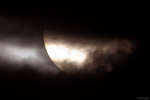 Mercurys Transit: An Unusual Spot on the Sun
8.05.2016
What's that dot on the Sun? If you look closely, it is almost perfectly round. The dot is the result of an unusual type of solar eclipse that occurred in 2006. Usually it is the Earth's Moon that eclipses the Sun. This time, the planet Mercury took a turn.
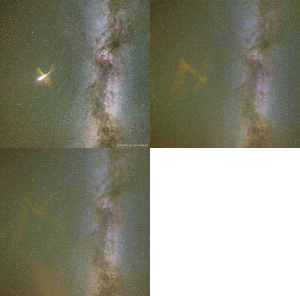 Milky Way and Exploding Meteor
6.08.2017
Next weekend the Perseid Meteor Shower reaches its maximum. Grains of icy rock will streak across the sky as they evaporate during entry into Earth's atmosphere. These grains were shed from Comet Swift-Tuttle.
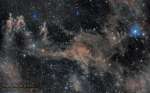 Stardust in Aries
9.12.2017
This composition in stardust covers over 8 degrees on the northern sky. The mosaicked field of view is west of the familiar Pleiades star cluster, toward the zodiacal constellation Aries and the plane of our Milky Way Galaxy.
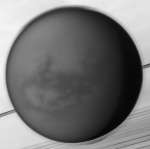 Titan: Moon over Saturn
26.05.2018
Like Earth's moon, Saturn's largest moon Titan is locked in synchronous rotation. This mosiac of images recorded by the Cassini spacecraft in May of 2012 show's its anti-Saturn side, the side always facing away from the ringed gas giant.
|
January February March April May June July August September |
|||||||||||||||||||||||||||||||||||||||||||||||||