
|
You entered: sky
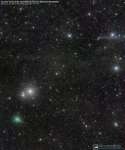 A Conjunction of Comets
23.09.2017
A conjunction of comets is captured in this pretty star field from the morning of September 17. Discovered in July by a robotic sky survey searching for supernovae, comet C/2017 O1 ASASSN is at the lower left. The visible greenish glow of its coma is produced by the fluorescence of diatomic carbon molecules in sunlight.
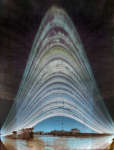 The Longer Days
27.06.2019
This persistent six month long exposure compresses the time from solstice to solstice (December 21, 2018 to June 16, 2019) into a single point of view. Dubbed a solargraph, the unconventional picture was recorded with a tall, tube-shaped pinhole camera using a piece of photographic paper.
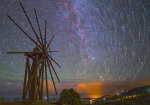 The Windmill and the Star Trails
17.04.2020
Stars can't turn these old wooden arms, but it does look like they might in this scene from a rotating planet. The well-composed night skyscape was recorded from Garafia, a municipality on the island of La Palma, Canary Islands, planet Earth.
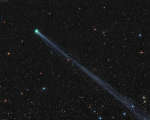 Long Tailed Comet SWAN
8.05.2020
Blowing in the solar wind the spectacular ion tail of Comet SWAN (C/2020 F8) extends far across this 10 degree wide telephoto field of view. Captured on May 2 its greenish coma was about 6 light-minutes from Earth. The pretty background starfield lies near the border of the constellations Cetus and Aquarius.
 A Digital Lunar Eclipse
19.05.2022
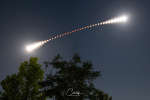
Recorded on May 15/16 this sequence of exposures follows the Full Moon during a total lunar eclipse as it arcs above treetops in the clearing skies of central Florida. A frame taken every 5 minutes by a digital camera shows the progression of the eclipse over three hours.
 Orions Horsehead Nebula
29.01.2003
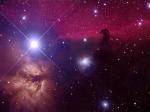
The Horsehead Nebula is one of the most famous nebulae on the sky. It is visible as the dark indentation to the red emission nebula seen above and to the right of center in the above photograph. The bright star on the left is located in the belt of the familiar constellation of Orion.
 Leonid Meteor Shower Next Week
8.11.1998
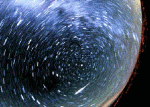
Early next week, a spectacular meteor storm is expected: the 1998 Leonids. It is widely thought that that the meteors from the Leonids meteor shower are just small pieces of Comet Temple-Tuttle falling to Earth.
 Iridium 52: Not A Meteor
22.10.1999
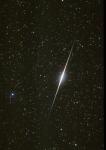
While hunting for meteors in the night sky above the White Mountains near Bishop, California, astrophotographer James Young instead captured this brilliant celestial apparition. Recorded near twilight on August 13, the bright streak is not the flash of a meteor trail but sunlight glinting from a satellite.
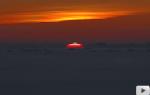 Movie: A Green Flash Over Italy
29.01.2007
How could the Sun turn green? Difficult to observe, the momentary green flash above the rising or setting sun has been documented as a phenomenon caused by the atmospheric bending or refraction of sunlight.
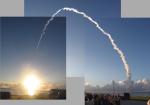 Dawn Launch Mosaic
29.09.2007
Shortly after sunrise on Thursday at Cape Canaveral Air Force Station, the Dawn spacecraft began its journey to the asteroid belt, arcing eastward into a blue and cloudy sky. Dawn's voyage began on a conventional, chemically fueled Delta II rocket, but will continue with an innovative ion propulsion system.
|
January February March April May June July August September October |
|||||||||||||||||||||||||||||||||||||||||||||||||