
|
You entered: sky
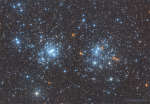 A Double Star Cluster in Perseus
22.11.2022
Few star clusters this close to each other. Visible to the unaided eye from dark sky areas, it was cataloged in 130 BC by Greek astronomer Hipparchus. Some 7,000 light-years away, this pair...
 APOD: 2025 February 17 Б SpaceX Rocket Launch Plume over California
17.02.2025
What's happened to the sky? Last Monday, the photogenic launch plume from a SpaceX rocket launch created quite a spectacle over parts of southern California and Arizona. Looking at times like a giant...
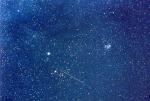 A Leonids Star Field
20.11.2001
As meteor after meteor streaked across a moonless sky, photographers across the world snapped pictures of the 2001 Leonids Meteor Shower. Many recognized this as the best meteor shower they had ever seen. In fact, the 2001 Leonids was the most active meteor shower since the mid-1960s.
 Spirit Rover Reaches the Columbia Hills on Mars
28.06.2004
The Spirit robotic rover on Mars has now reached the Columbia Hills on Mars. Two of the hills are shown on approach near the beginning of June. The above true-color picture shows very nearly what a human would see from Spirit's vantage point.
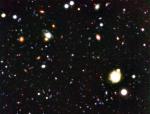 The NTT SUSI Deep Field
15.09.1998
What happens if you point a large telescope at nothing? The above New Technology Telescope SUSI Deep Field photograph isolated a small patch of sky picked to contain no bright objects at all.
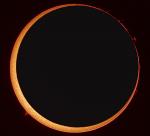 An Annular Solar Eclipse at High Resolution
5.10.2005
On Monday, part of the Sun went missing. The missing piece was no cause for concern -- the Moon was only momentarily in the way. The event was not a total eclipse of the Sun for any Earth-bound sky enthusiast but rather, at best, an annular eclipse, where the Moon blocked most of the Sun.
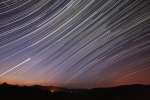 Star Trails at Dawn
8.12.2007
Just fix your camera to a tripod and you too can make an image of graceful trails traced by the stars as planet Earth rotates on its axis. Made on September 14 from Montlaux...
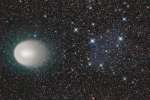 Amazing Comet Holmes
24.10.2008
One year ago, Comet 17P/Holmes amazed sky watchers across planet Earth. A stunningly rapid outburst transformed it from a faint comet quietly orbiting the Sun with a period of about 7 years to a naked-eye comet rivaling the brighter stars in the constellation Perseus.
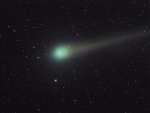 Comet Lulin and Distant Galaxies
7.03.2009
Now fading in our night sky, Comet Lulin has provided some lovely cosmic vistas. Moving rapidly against the background of stars, Lulin briefly posed with the likes of Saturn, and Regulus (Alpha Leo). But here it is seen against a field of distant galaxies.
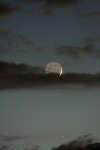 Framed by Clouds
30.04.2009
Last Sunday's fading evening twilight featured a young crescent Moon along the western horizon. The young Moon also shared the sky with the lovely Pleiades star cluster and wandering planet Mercury. Framed by clouds in this serene skyscape from Selsey, UK, a similar twilight scene was visible around the globe.
|
January February March April May June July August September October |
|||||||||||||||||||||||||||||||||||||||||||||||||