
|
You entered: telescope
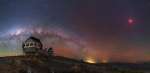 Eclipsed in Southern Skies
30.09.2015
This stunning panorama in southern skies was recorded on the colorful night of September 27/28 from Carngegie Las Campanas Observatory. A diffuse glow and dark rifts of the central Milky Way hang over domes of the twin 6.5 meter Magellan telescopes. But most eye-catching is the deep red glow of the Moon.
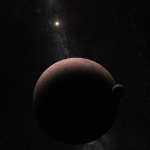 Moon over Makemake
29.04.2016
Makemake, second brightest dwarf planet of the Kuiper belt, has a moon. Nicknamed MK2, Makemake's moon reflects sunlight with a charcoal-dark surface, about 1,300 times fainter than its parent body. Still...
 Fermi Science Playoffs
7.06.2018
NASA's Fermi Gamma-ray Space Telescope was launched into orbit on June 11th, 2008. Its instruments detect gamma-rays -- light that is thousands to hundreds of billions of times more energetic than what we see with our eyes.
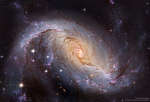 NGC 1672: Barred Spiral Galaxy from Hubble
8.10.2018
Many spiral galaxies have bars across their centers. Even our own Milky Way Galaxy is thought to have a modest central bar. Prominently barred spiral galaxy NGC 1672, featured here, was captured in spectacular detail in an image taken by the orbiting Hubble Space Telescope.
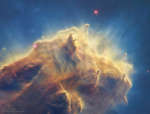 Star Formation in the Eagle Nebula
13.03.2022
Where do stars form? One place, star forming regions known as "EGGs", are being uncovered at the end of this giant pillar of gas and dust in the Eagle Nebula (M16). Short for evaporating gaseous globules, EGGs are dense regions of mostly molecular hydrogen gas that fragment and gravitationally collapse to form stars.
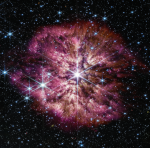 Wolf Rayet 124
17.03.2023
Driven by powerful stellar winds, expanding shrouds of gas and dust frame hot, luminous star Wolf-Rayet 124 in this sharp infrared view. The eye-catching 6-spike star pattern is characteristic of stellar images made with the 18 hexagonal mirrors of the James Webb Space Telescope.
 APOD: 2025 August 18 Б NGC 1309: A Useful Spiral Galaxy
17.08.2025
This galaxy is not only pretty -- it's useful. A gorgeous spiral some 100 million light-years distant, NGC 1309 lies on the banks of the constellation of the River (Eridanus). NGC 1309 spans about 30,000 light-years, making it about one third the size of our larger Milky Way galaxy.
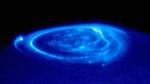 A Close Up of Aurora on Jupiter
18.12.2000
Jupiter has aurorae. Like Earth, the magnetic field of the gas giant funnels charged particles released from the Sun onto the poles. As these particles strike the atmosphere, electrons are temporarily knocked away from existing gas molecules. Electric force attracts these electrons back. As the electrons recombine to remake neutral molecules, auroral light is emitted.
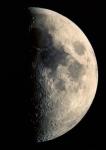 The Moon and All the Crashes
28.04.2001
A clear blue summer sky finally grows dark and the new telescope, hastily set up in the backyard, generates excitment and anticipation. "I bought it for the kids.", Dad assures himself as he anxiously supervises two young boys' efforts to center a bright, first quarter Moon in the finder.
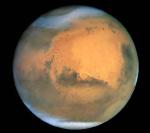 Mars from Earth
18.07.2001
Last month, Mars and Earth were right next to each other in their orbits. Formally called opposition, the event was highlighted by a very bright Mars for skywatchers and a good photo opportunity for the Hubble Space Telescope. Above, Hubble snapped the highest resolution picture of Mars ever obtained from the Earth.
|
January February March April May June July August September October |
|||||||||||||||||||||||||||||||||||||||||||||||||