
|
You entered: telescope
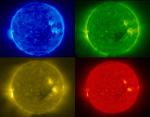 The View from Stereo Ahead
22.12.2006
On December 22nd, at 0022 Universal Time the Sun reached its southernmost point in Earth's sky marking the final season change for the year 2006. In celebration of the Solstice, consider these images of the Sun from an extreme ultraviolet telescope onboard the Stereo Ahead spacecraft.
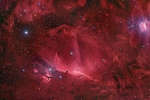 Wisps Surrounding the Horsehead Nebula
6.04.2008
The famous Horsehead Nebula in Orion is not alone. A deep exposure shows that the dark familiar shaped indentation, visible just below center, is part of a vast complex of absorbing dust and glowing gas.
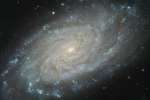 Spiral Galaxy NGC 3370 from Hubble
12.10.2008
Is this what our own Milky Way Galaxy looks like from far away? Similar in size and grand design to our home Galaxy (although without the central bar), spiral galaxy NGC 3370 lies about 100 million light-years away toward the constellation of the Lion (Leo).
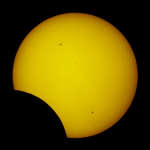 Eclipsing the Sun
5.01.2011
Skywatchers throughout much of Europe, North Africa, and Central Asia, were treated to the first eclipse of the new year on January 4, a partial eclipse of the Sun. But traveling to the area...
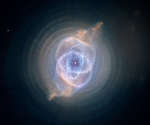 The Cat s Eye Nebula from Hubble
24.04.2011
Staring across interstellar space, the alluring Cat's Eye nebula lies three thousand light-years from Earth. A classic planetary nebula, the Cat's Eye (NGC 6543) represents a final, brief yet glorious phase in the life of a sun-like star.
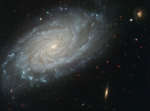 Spiral Galaxy NGC 3370 from Hubble
29.10.2011
Is this what our own Milky Way Galaxy looks like from far away? Similar in size and grand design to our home Galaxy (although without the central bar), spiral galaxy NGC 3370 lies about 100 million light-years away toward the constellation of the Lion (Leo).
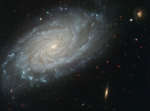 NGC 3370: A Sharper View
8.08.2013
Similar in size and grand design to our own Milky Way, spiral galaxy NGC 3370 lies about 100 million light-years away toward the constellation Leo. Recorded here in exquisite detail by the Hubble Space...
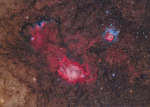 A Sagittarius Triplet
30.08.2013
These three bright nebulae are often featured in telescopic tours of the constellation Sagittarius and the crowded starfields of the central Milky Way. In fact, 18th century cosmic tourist Charles Messier cataloged two of them; M8, the large nebula left of center, and colorful M20 on the right.
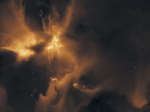 A Particle Beam Jet forms HH 24
4.02.2014
If you visit HH 24, don't go near the particle beam jet. This potential future travel advisory might be issued because the powerful jet likely contains electrons and protons moving hundreds of kilometers per second.
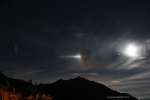 Moondog Night
10.12.2014
In this night scene from the early hours of November 14, light from a last quarter Moon illuminates clouds above the mountaintop domes of Kitt Peak National Observatory near Tucson, Arizona. Bright Jupiter...
|
January February March April May June July August September October |
|||||||||||||||||||||||||||||||||||||||||||||||||