
|
You entered: telescope
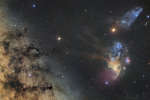 Saturn and Mars visit Milky Way Star Clouds
10.05.2016
Planets, stars, nebulas and a galaxy -- this impressive image has them all. Closest to home are the two planets Mars (right) and Saturn (center), visible as the two bright orange spots in the upper half of the featured image.
 NGC 7331 Close Up
7.02.2018
Big, beautiful spiral galaxy NGC 7331 is often touted as an analog to our own Milky Way. About 50 million light-years distant in the northern constellation Pegasus, NGC 7331 was recognized early on as a spiral nebula and is actually one of the brighter galaxies not included in Charles Messier's famous 18th century catalog.
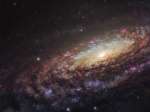 NGC 7331 Close Up
7.02.2020
Big, beautiful spiral galaxy NGC 7331 is often touted as an analog to our own Milky Way. About 50 million light-years distant in the northern constellation Pegasus, NGC 7331 was recognized early on as a spiral nebula and is actually one of the brighter galaxies not included in Charles Messier's famous 18th century catalog.
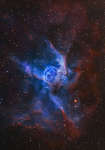 NGC 2359: Thor s Helmet
12.06.2020
NGC 2359 is a helmet-shaped cosmic cloud with wing-like appendages popularly called Thor's Helmet. Heroically sized even for a Norse god, Thor's Helmet is about 30 light-years across. In fact, the helmet...
 Pixels in the Sun
26.06.2021
These two panels, composed of video frames made with a safe solar telescope and hydrogen alpha filter, show remarkably sharp details on the solar disk and giant prominences along the Sun's edge on June 6 (top) and June 18.
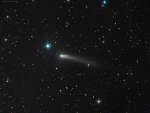 Rosetta's Comet in View
10.09.2021
Faint comet Churyumov-Gerasimenko (67P) sweeps past background stars in the constellation Taurus and even fainter distant galaxies in this telescopic frame from September 7. About 5 years ago, this comet's 4 kilometer spanning...
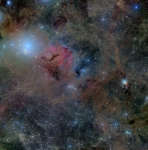 Stardust in Perseus
12.01.2023
This cosmic expanse of dust, gas, and stars covers some 6 degrees on the sky in the heroic constellation Perseus. At upper left in the gorgeous skyscape is the intriguing young star cluster IC 348 and neighboring Flying Ghost Nebula with clouds of obscuring interstellar dust cataloged as Barnard 3 and 4.
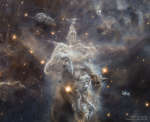 APOD: 2026 April 26 Б Mystic Mountain Monster being Destroyed
26.04.2026
Inside the head of this interstellar monster is a star that is slowly destroying it. The huge monster, actually an inanimate series of pillars of gas and dust, measures light years in length.
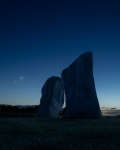 APOD: 2026 June 12 Б Venus and Jupiter: Conjunction from Avebury
12.06.2026
To see Venus and Jupiter together this month, you won't need binoculars or even a telescope. Just look up after sunset and you'll find them emerging as the sky grows dark near the western horizon.
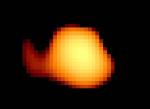 Resolving Mira
21.01.2001
Most stars appear only as points of light. In 1995, Betelgeuse became the second star, after our Sun, to have it surface resolved. Later that year, Mira was added to the list. Mira...
|
January February March April May June July August September October |
|||||||||||||||||||||||||||||||||||||||||||||||||