
|
You entered: Moon
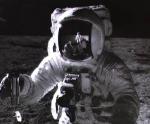 Apollo 12: Self-Portrait
4.11.2000
Is it art? In November of 1969, Apollo 12 astronaut-photographer Charles "Pete" Conrad recorded this masterpiece while documenting colleague Alan Bean's lunar soil collection activities on the Oceanus Procellarum. The image is dramatic and stark. Bean is faceless.
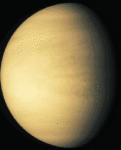 Venus: Earth's Sister Planet
15.08.1995
This picture in visible light was taken by the Galileo spacecraft. Venus is very similar to Earth in size and mass - and so is sometimes referred to as Earth's sister planet - but Venus has a quite different climate.
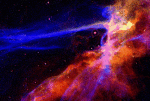 Rampaging Fronts of the Veil Nebula
7.03.1996
A supernova explosion of a high-mass star results in fast moving blast waves. At the front of the waves shown above, ionized gas in the Veil Supernova Remnant rushes out from the explosion, sweeps up material, and breaks up many atoms into constituent ions and electrons.
 On the Possibility of Ascending to Mars
19.10.2005
On another October 19, in 1899, a 17 year-old Robert Goddard climbed a cherry tree on a beautiful autumn afternoon in Worcester, Massachusetts. Inspired by H.G. Wells' War of the Worlds and gazing...
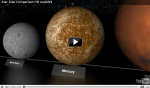 Star Size Comparisons
22.02.2011
How big is our Sun compared to other stars? In a dramatic and popular video featured on YouTube, the relative sizes of planets and stars are shown from smallest to largest. The above video starts with Earth's Moon and progresses through increasingly larger planets in our Solar System.
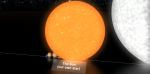 Star Size Comparisons
6.06.2013
How big is our Sun compared to other stars? In a dramatic and popular video featured on YouTube, the relative sizes of planets and stars are shown from smallest to largest. The above video starts with Earth's Moon and progresses through increasingly larger planets in our Solar System.
 A Perseid Aurora
9.08.2003
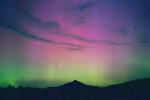
Just after the Moon set but before the Sun rose in the early morning hours of 2000 August 12, meteors pelted the Earth from the direction of the constellation Perseus, while ions pelted the Earth from the Sun.
 The Surface of Titan
4.08.1999
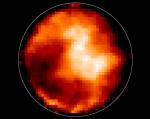
If sailing the hydrocarbon seas of Titan, beware of gasoline rain. Such might be a travel advisory issued next millennium for adventurers visiting Titan, the largest moon of Saturn. Images of Titan's surface were released last week from the Keck 10-meter telescope featuring the finest details yet resolved.
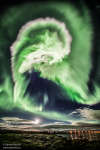 A Spiral Aurora over Iceland
12.09.2021
What's happened to the sky? Aurora! Captured in 2015, this aurora was noted by Icelanders for its great brightness and quick development. The aurora resulted from a solar storm, with high energy particles bursting out from the Sun and through a crack in Earth's protective magnetosphere a few days later.
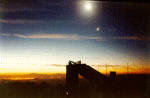 The McMath-Pierce Solar Observatory
15.03.1996
This odd-looking structure silhouetted in the foreground houses the three largest solar telescopes in the world. Located in Kitt Peak, Arizona, the largest telescope inside the McMath-Pierce Facility is 1.6-meters in diameter and contains only mirrors. The telescope contains no windows or lenses because focusing bright sunlight would overheat them.
|
January February March April May June July August September October |
|||||||||||||||||||||||||||||||||||||||||||||||||