
|
You entered: Moon
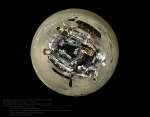 Yutu on a Little Planet
13.02.2016
Tracks lead to a small robot perched near the top of this bright little planet. Of course, the planet is really the Moon. The robot is the desk-sized Yutu rover, leaving its looming Chang'e 3 lander after a after a mid-December 2013 touch down in the northern Mare Imbrium.
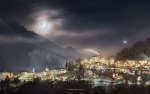 A Lunar Corona with Jupiter and Saturn
19.01.2021
Why does a cloudy moon sometimes appear colorful? The effect, called a lunar corona, is created by the quantum mechanical diffraction of light around individual, similarly-sized water droplets in an intervening but mostly-transparent cloud. Since light of different colors has different wavelengths, each color diffracts differently.
 APOD: 2025 August 7 Б The Double Cluster in Perseus
7.08.2025
This stunning starfield spans about three full moons (1.5 degrees) across the heroic northern constellation of Perseus. It holds the famous pair of open star clusters, h and Chi Persei. Also cataloged...
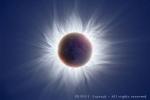 The Big Corona
15.09.1999
Most photographs don't adequately portray the magnificence of the Sun's corona. Seeing the corona first-hand during a total solar eclipse is best. The human eye can adapt to see features and extent that photographic film usually cannot. Welcome, however, to the digital age.
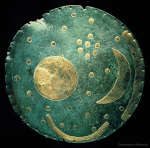 The Nebra Sky Disk
19.03.2018
It is considered the oldest known illustration of the night sky. But what, exactly, does it depict, and why was it made? The Nebra sky disk was found with a metal detector in 1999 by treasure hunters near Nebra, Germany, in the midst of several bronze-age weapons.
 NGC 7814: Little Sombrero
23.01.2025
Point your telescope toward the high flying constellation Pegasus and you can find this cosmic expanse of Milky Way stars and distant galaxies. NGC 7814 is centered in the sharp field of view that would almost be covered by a full moon.
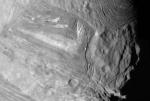 Miranda
19.02.1998
Miranda is a bizarre world which surely had a tempestuous past. The innermost of the larger Uranian moons, Miranda is almost 300 miles in diameter and was discovered only 50 years ago (February 16, 1948) by the renown American planetary astronomer Gerard Kuiper.
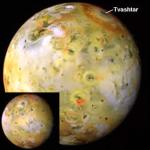 A Newly Active Volcano On Jupiters Io
16.10.2001
Would a volcano plume discovered in January above Jupiter's Moon Io still be active months later? To answer this question, the robot spacecraft Galileo currently in orbit around Jupiter was maneuvered to image the plume site during its recent flyby of Io in August.
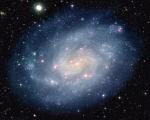 Spiral Galaxy NGC 300
21.08.2002
NGC 300 is so interesting because it is so normal. An Sc-type spiral galaxy in the nearby Sculptor group of galaxies, NGC 300 shows typical flowing blue spiral arms, an expected compact nucleus, and the requisite amount of stars, star clusters, and nebulae.
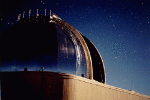 IRTF: Scanning the Infrared Skies
4.09.1996
Above, NASA's Infrared Telescope Facility (IRTF) poses in front of a starry background. Located on top of Hawaii's towering volcano Mauna Kea, the IRTF is the premier telescope for observing in near infrared light. This 3-meter telescope was established in 1979 and spends about half its time observing Solar System objects.
|
January February March April May June July August September October |
|||||||||||||||||||||||||||||||||||||||||||||||||