
|
You entered: ring
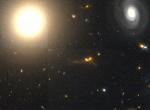 Elliptical Galaxy NGC 4881 in Coma
21.11.1999
Elliptical galaxies are unlike spiral galaxies and hence unlike our own Milky Way Galaxy. The giant elliptical galaxy named NGC 4881 on the upper left lies at the edge of the giant Coma Cluster of Galaxies.
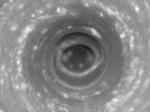 A Hurricane Over the South Pole of Saturn
13.11.2006
What's happening at the south pole of Saturn? To find out, scientists sent the robot Cassini probe now orbiting Saturn directly over the lower spin axis of the ringed giant. Cassini found there a spectacular massive swirling storm system with a well developed eye-wall, similar to a hurricane here on Earth.
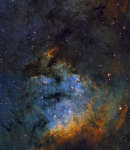 NGC 7822 in Cepheus
22.10.2010
Pillars of gas, dust, and young, hot stars seem to fill the gaping maw of NGC 7822. At the edge of a giant molecular cloud toward the northern constellation Cepheus, the glowing star forming region lies about 3,000 light-years away. Within the nebula, bright edges and dark shapes are highlighted in this colorful skyscape.
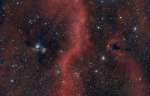 Decorating the Sky
25.12.2010
Bright stars, clouds of dust and glowing nebulae decorate this cosmic scene, a skyscape just north of Orion's belt. Close to the plane of our Milky Way Galaxy, the wide field view spans about 5.5 degrees. Striking bluish M78, a reflection nebula, is at the left.
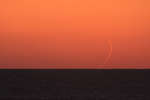 Moonset from Taiwan
14.08.2013
It took three worlds to create this simple image. The first world was the Earth, which was quite prominent. The dividing line running horizontally below the middle separates sea from sky. On this part of the Earth, it was almost nighttime. The second world was the Moon, which was almost invisible.
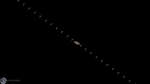 International Space Station Transits Saturn
22.01.2016
From low Earth orbit to the outer Solar System, this remarkable video frame composite follows the International Space Station's transit of Saturn. On January 15, the well-timed capture from a site near Dulmen, Germany required telescope and camera to be positioned along the predicted transit centerline, a path only 40 meters wide.
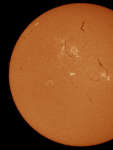 A Transit of Mercury
12.05.2016
On May 9, the diminutive disk of Mercury spent about seven and a half hours crossing in front of the Sun as viewed from the general vicinity of Earth. It was the second of 14 transits of the Solar System's innermost planet in the 21st century.
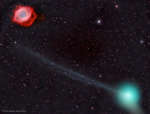 Comet PanSTARRS and the Helix Nebula
5.06.2016
It's rare that such different objects are imaged so close together. Such an occasion is occurring now, though, and was captured two days ago in combined parallel exposures from the Canary Islands of Spain.
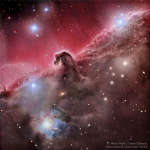 The Magnificent Horsehead Nebula
25.12.2016
Sculpted by stellar winds and radiation, a magnificent interstellar dust cloud by chance has assumed this recognizable shape. Fittingly named the Horsehead Nebula, it is some 1,500 light-years distant, embedded in the vast Orion cloud complex.
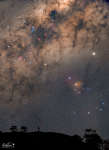 The Galaxy Above
15.10.2019
Have you contemplated your home galaxy lately? If your sky looked like this, perhaps you'd contemplate it more often! The featured picture is actually a composite of two images taken last month from the same location in south Brazil and with the same camera -- but a few hours apart.
|
January February March April May June July August September October |
|||||||||||||||||||||||||||||||||||||||||||||||||