
|
You entered: ring
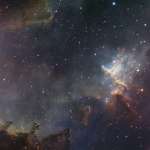 Melotte 15 in the Heart
9.11.2012
Cosmic clouds seem to form fantastic shapes in the central regions of emission nebula IC 1805. Of course, the clouds are sculpted by stellar winds and radiation from massive hot stars in the nebula's newborn star cluster, Melotte 15.
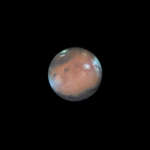 Mars near Opposition
11.04.2014
Tonight Mars is between opposition (April 8) and closest approach (April 14) looping through the constellation Virgo opposite the Sun in the night sky. That makes it prime season for telescopic views of the the Red Planet, like this one from April 3rd.
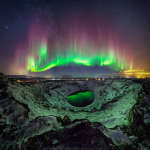 Colorful Aurora over Iceland
6.03.2017
You don't always see a scene this beautiful when you hike to an ancient volcano -- you have to be lucky. When the astrophotographer realized that aurora were visible two-weeks ago, he made a night-time run for the top of the caldera to see if he could capture them also reflected in the central lake.
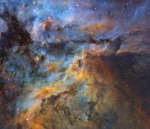 South of Carina
22.05.2020
With natal dust clouds in silhouette against glowing atomic gas, this colorful and chaotic vista lies within one of the largest star forming regions in the Milky Way galaxy, the Great Carina Nebula.
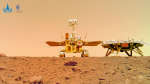 Zhurong: New Rover on Mars
15.06.2021
There's a new rover on Mars. In mid-May, China's Tianwen-1 mission delivered the Zhurong rover onto the red planet. As Mars means Planet of Fire in Chinese, the Zhurong rover's name means, roughly, God of Fire in Chinese mythology.
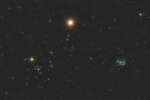 Mars and the Star Clusters
30.12.2022
At this year's end Mars still shines brightly in planet Earth's night as it wanders through the head-strong constellation Taurus. Its bright yellowish hue dominates this starry field of view that includes Taurus' alpha star Aldebaran and the Hyades and Pleiades star clusters.
 APOD: 2025 March 4 Б A Quadruple Alignment over Italy
4.03.2025
Why does this Moon look so unusual? A key reason is its vivid red color. The color is caused by the deflection of blue light by Earth's atmosphere -- the same reason that the daytime sky appears blue. The Moon also appears unusually distorted.
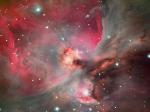 The Great Nebula in Orion
13.02.2002
Few astronomical sights excite the imagination like the nearby stellar nursery known as the Orion Nebula. The Nebula's glowing gas surrounds hot young stars at the edge of an immense interstellar molecular cloud only 1500 light-years away.
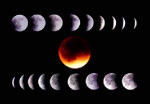 Tonight: A Total Lunar Eclipse
26.09.1996
Tonight brings the last total lunar eclipse visible from North America until the year 2000 - with the Moon becoming completely immersed in Earth's shadow. The above time-lapse photograph shows a lunar eclipse that occurred in April 1993.
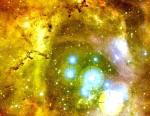 In the Center of the Rosette Nebula
29.04.2003
In the heart of the Rosette Nebula lies a bright open cluster of stars that lights up the nebula. The stars of NGC 2244 formed from the surrounding gas only a few million years ago. This just-released image taken by the CFHT's new MegaPrime camera shows the region in unprecedented detail.
|
January February March April May June July August September October |
|||||||||||||||||||||||||||||||||||||||||||||||||