
|
You entered: clouds
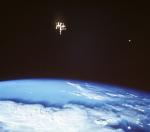 The Moons Of Earth
27.01.2001
While orbiting the planet during their June 1998 mission, the crew of the Space Shuttle Discovery photographed this view of two moons of Earth. Thick storm clouds are visible in the lovely blue planet...
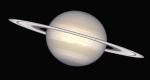 Natural Saturn On The Cassini Cruise
11.05.2002
What could you see approaching Saturn aboard an interplanetary cruise ship? Your view would likely resemble this subtly shaded image of the gorgeous ringed gas giant. Processed by the Hubble Heritage project, the picture...
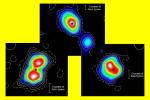 Three Dusty Stars
23.04.1998
These separate radio images reveal three dusty debris disks surrounding three bright, young, nearby stars - evidence for solar systems in formation. From left to right are the stars Fomalhaut, Beta Pictoris, and Vega, their positions indicated by star symbols. The false color maps show the intensity of submillimeter radio emission from the surrounding dust.
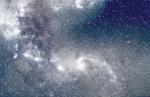 NGC4039: Starbirth and Galaxy Death
6.05.1997
Do star clusters form when galaxies collide? Quite possibly, according to Hubble Space Telescope observations of the "Antennae", two galaxies thought to be in the early stages of a collision.
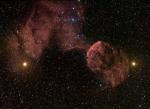 Elusive Jellyfish Nebula
8.04.2004
Normally faint and elusive, the Jellyfish Nebula is caught in the net of this spectacular wide-field telescopic view. Flanked by two yellow-tinted stars at the foot of a celestial twin - Mu and Eta Geminorum - the Jellyfish Nebula is the brighter arcing ridge of emission with dangling tentacles just right of center.
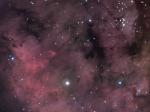 The Star Pillars of Sharpless 171
27.09.2005
Towering pillars of cold gas and dark dust adorn the center star forming region of Sharpless 171. An open cluster of stars is forming there from the gas in cold molecular clouds. As energetic...
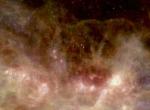 The W4 Chimney
7.02.2000
A huge chimney venting hot clouds of gas out from the plane of our Milky Way Galaxy has recently been imaged in radio waves. The Canadian Galactic Plane Survey team used an array of radio telescopes to survey an ionized gas region known as W4.
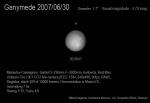 Astronomer s Moon
24.08.2007
Jupiter is an astronomer's planet -- its large size and contrasting global cloud belts and zones allow detailed studies with a range of earthbound telescopes. On the other hand, most telescopic views of Jupiter's moons usually show only featureless, tantalizing points of light hovering near the ruling gas giant.
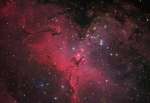 M16 and the Eagle Nebula
19.07.2008
Young star cluster M16 is surrounded by natal clouds of cosmic dust and glowing gas also known as The Eagle Nebula. This beautifully detailed image of the region includes fantastic shapes made famous in well-known Hubble Space Telescope close-ups of the starforming complex.
 NGC 7822 in Cepheus
28.08.2009
Pillars of gas, dust, and young, hot stars fill the center of NGC 7822. At the edge of a giant molecular cloud toward the northern constellation Cepheus, the glowing star forming region lies about 3,000 light-years away. Within the nebula, bright edges and tantalizing shapes are highlighted in this colorful skyscape.
|
January February March April May June July August September October |
|||||||||||||||||||||||||||||||||||||||||||||||||