
|
You entered: clouds
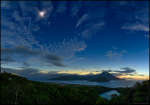 Dark Sun over Ternate
10.03.2016
A dark Sun hangs in the clearing sky over a volcanic planet in this morning sea and skycape. It was taken during this week's total solar eclipse, a dramatic snapshot from along the narrow path of totality in the dark shadow of a New Moon.
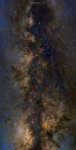 Great Rift Near the Center of the Milky Way
10.11.2016
Over 100 telescopic image panels in this stunning vertical mosaic span about 50 degrees across the night sky. They follow part of the Great Rift, the dark river of dust and molecular gas that stretches along the plane of our Milky Way Galaxy.
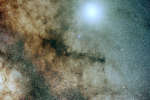 The Planet and the Pipe
7.06.2019
Now posing against our galaxy's rich starfields and nebulae, brilliant planet Jupiter shines in the night sky. Its almost overwhelming glow is near the top of the frame in this colorful telephoto portrait of the central Milky Way.
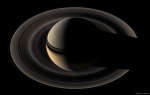 Crescent Saturn
7.07.2019
Saturn never shows a crescent phase -- from Earth. But when viewed from beyond, the majestic giant planet can show an unfamiliar diminutive sliver. This image of crescent Saturn in natural color was taken by the robotic Cassini spacecraft in 2007.
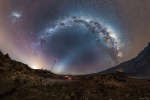 Milky Way and Zodiacal Light over Chile
9.03.2020
What is the band of light connecting the ground to the Milky Way? Zodiacal light -- a stream of dust that orbits the Sun in the inner Solar System. It is most easily seen just before sunrise, where it has been called a false dawn, or just after sunset.
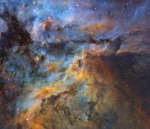 South of Carina
22.05.2020
With natal dust clouds in silhouette against glowing atomic gas, this colorful and chaotic vista lies within one of the largest star forming regions in the Milky Way galaxy, the Great Carina Nebula.
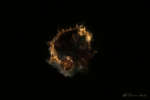 A Falcon 9 Nebula
4.09.2021
Not the Hubble Space Telescope's latest view of a distant galactic nebula, this illuminated cloud of gas and dust dazzled early morning spacecoast skygazers on August 29. The snapshot was taken at 3:17am from Space View Park in Titusville, Florida.
 The Protostars within Lynds 483
13.03.2025
Two protostars are hidden in a single pixel near the center of a striking hourglass-shaped nebula in this near-infrared image from the James Webb Space Telescope. The actively forming star system lies in a dusty molecular cloud cataloged as Lynds 483, some 650 light-years distant toward the constellation Serpens Cauda.
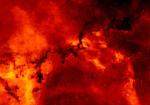 Hydrogen and Dust in the Rosette Nebula
23.12.2005
At the edge of a large molecular cloud in Monoceros, some 3,000 light years away, dark filaments of dust are silhouetted by luminous hydrogen gas. The close up view of the Rosette Nebula...
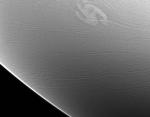 Saturn Storm by Ringshine
23.02.2006
Imaged on the night side of Saturn by the Cassini spacecraft, these swirling storm clouds are illuminated by ringshine - sunlight reflected from the gas giant's magnificent ring system. The storm (top) was actually spotted last month by amateur astronomers as it rotated across Saturn's day side and spans about 3,500 kilometers.
|
January February March April May June July August September October |
|||||||||||||||||||||||||||||||||||||||||||||||||