
|
You entered: clouds
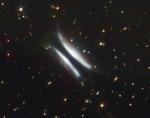 Gomezs Hamburger: A Proto Planetary Nebula
7.08.2002
What, in heaven, is that? Sometimes astronomers see things on the sky they don't immediately understand. In 1985 this happened to Arturo Gomez, and the object became known as Gomez's Hamburger for its distinctive yet familiar shape.
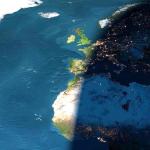 A Digital Sunset Over Europe and Africa
24.03.2003
No single spacecraft or astronaut took this picture. It is a digital composite of archived images taken over many orbits by several Earth-orbiting satellites. Similar images can be digitally stitched together for any Earth location by John Walker's Earth and Moon Viewer website.
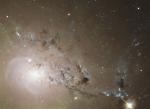 NGC 1275: A Galactic Collision
5.05.2003
In NGC 1275, one galaxy is slicing through another. The disk of the dusty spiral galaxy near the image center is cutting through a large elliptical galaxy, visible predominantly on the lower left. Galaxies...
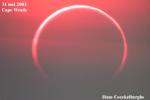 Ring of Fire from Cape Wrath
5.06.2003
If the Moon's apparent diameter is not quite large enough to cover the Sun during a solar eclipse, an annular eclipse can be the result -- a spectacle of silhouetted Moon surrounded by a solar "ring of fire".
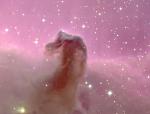 The Horsehead Nebula
13.07.2003
One of the most identifiable nebulae in the sky, the Horsehead Nebula in Orion, is part of a large, dark, molecular cloud. Also known as Barnard 33, the unusual shape was first discovered on a photographic plate in the late 1800s.
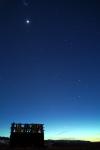 Mercury and Venus in the West
2.04.2004
Doing their part in the ongoing dance of the planets, Mercury and Venus both reached their greatest elongation or maximum apparent distance from the Sun only a few days ago, on March 29th. Eager...
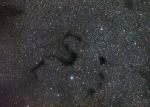 Snake in the Dark
21.05.2005
Dark nebulae snake across a gorgeous expanse of stars in this wide-field view toward the pronounceable constellation Ophiucus and the center of our Milky Way Galaxy. In fact, the central S-shape seen here is well known as the Snake Nebula.
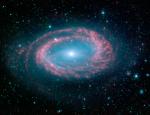 One Armed Spiral Galaxy NGC 4725
1.09.2005
While most spiral galaxies, including our own Milky Way, have two or more spiral arms, peculiar galaxy NGC 4725 has only one. In this false-color Spitzer Space Telescope infrared image, the galaxy's solo spira mirabilis is seen in red, highlighting the emission from dust clouds warmed by newborn stars.
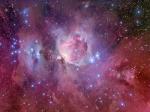 M42: Wisps of the Orion Nebula
20.11.2006
The Great Nebula in Orion, an immense, nearby starbirth region, is probably the most famous of all astronomical nebulas. Here, glowing gas surrounds hot young stars at the edge of an immense interstellar molecular cloud only 1500 light-years away. In the above deep image, faint wisps and sheets of dust and gas are particularly evident.
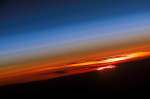 Sunset: Planet Earth
20.03.2008
Today, the Sun crosses the celestial equator heading north at 0548 UT. Known as the equinox, the geocentric astronomical event marks the first day of spring in the northern hemisphere and autumn in the south.
|
January February March April May June July August September October |
|||||||||||||||||||||||||||||||||||||||||||||||||