
|
You entered: dust
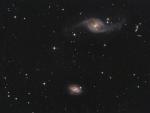 Galaxies in View
7.06.2005
Galaxies abound in this cosmic scene, a well chosen telescopic view toward the northern constellation of Ursa Major. Most noticeable are the striking pair of spiral galaxies - NGC 3718 (above, right) and NGC 3729 (below center) - a mere 52 million light-years distant.
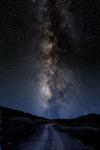 The Milky Road
20.10.2007
Inspired during a visit to Fort Davis, Texas, home of McDonald Observatory and dark night skies, photographer Larry Landolfi created this tantalizing fantasy view. The composited image suggests the Milky Way is a heavenly extension of a deserted country road.
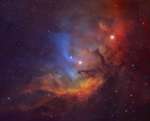 The Tulip in the Swan
26.07.2012
Framing a bright emission region this telescopic view looks out along the plane of our Milky Way Galaxy toward the nebula rich constellation Cygnus the Swan. Popularly called the Tulip Nebula the glowing cloud of interstellar gas and dust is also found in the 1959 catalog by astronomer Stewart Sharpless as Sh2-101.
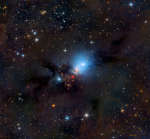 NGC 1333 Stardust
6.03.2014
NGC 1333 is seen in visible light as a reflection nebula, dominated by bluish hues characteristic of starlight reflected by dust. A mere 1,000 light-years distant toward the heroic constellation Perseus, it lies at the edge of a large, star-forming molecular cloud.
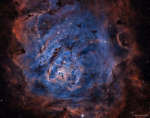 The Lagoon Nebula in Hydrogen Sulfur and Oxygen
5.01.2016
The majestic Lagoon Nebula is filled with hot gas and the home for many young stars. Spanning 100 light years across while lying only about 5000 light years distant, the Lagoon Nebula is so big and bright that it can be seen without a telescope toward the constellation of the Archer (Sagittarius).
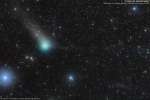 Comet PanSTARRS in the Southern Fish
17.06.2016
Now approaching our fair planet this Comet PanSTARRS (C/2013 X1) will come closest on June 21-22, a mere 5.3 light-minutes away. By then its appearance low in northern hemisphere predawn skies (high in the south), will be affected by the light of a nearly Full Moon, though.
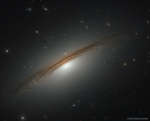 UGC 12591: The Fastest Rotating Galaxy Known
7.03.2017
Why does this galaxy spin so fast? To start, even identifying which type of galaxy UGC 12591 is difficult -- it has dark dust lanes like a spiral galaxy but a large diffuse bulge of stars like a lenticular.
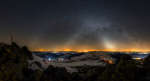 Arches of Spring
29.04.2017
Two luminous arches stretched across the dome of the sky on this northern spring night. After sunset on March 29, the mountain view panorama was captured in 57 exposures from Chopok peak in central Slovakia at an altitude of about 2,000 meters.
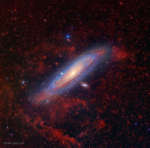 Clouds of Andromeda
8.01.2018
What are those red clouds surrounding the Andromeda galaxy? This galaxy, M31, is often imaged by planet Earth-based astronomers. As the nearest large spiral galaxy, it is a familiar sight with dark dust lanes, bright yellowish core, and spiral arms traced by clouds of bright blue stars.
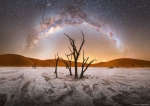 Milky Way over Deadvlei in Namibia
18.04.2018
What planet is this? It is the only planet currently known to have trees. The trees in Deadvlei, though, have been dead for over 500 years. Located in Namib-Naukluft Park in Namibia (Earth), saplings grew after rainfall caused a local river to overflow, but died after sand dunes shifted to section off the river.
|
January February March April May June July August September October |
|||||||||||||||||||||||||||||||||||||||||||||||||