
|
You entered: dust
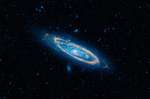 WISE Infrared Andromeda
19.02.2010
This sharp, wide-field view features infrared light from the spiral Andromeda Galaxy (M31). Dust heated by Andromeda's young stars is shown in yellow and red, while its older population of stars appears as a bluish haze. The false-color skyscape is a mosaic of images from NASA's new Wide-field Infrared Survey Explorer (WISE) satellite.
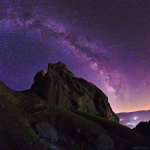 The Starry Night of Alamut
25.06.2010
A meteor's streak and the arc of the Milky Way hang over the imposing mountain fortress of Alamut in this starry scene. Found in the central Alborz Mountains of Iran, Alamut Castle was built into the rock in the 9th century. The name means Eagle's Nest.
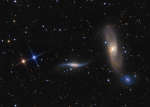 Arp 286: Trio in Virgo
13.08.2010
A remarkable telescopic composition in yellow and blue, this scene features a trio of interacting galaxies almost 90 million light-years away, toward the constellation Virgo. On the left, two, spiky, foreground Milky Way stars echo the trio galaxy hues, a reminder that stars in our own galaxy are like those in the distant island universes.
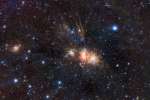 Vista with NGC 2170
15.10.2010
Drifting through the one-horned constellation Monoceros, these dusty streamers and new born stars are part of the active Monoceros R2 star-forming region, embedded in a giant molecular cloud. The cosmic scene was recorded by the VISTA survey telescope in near-infrared light.
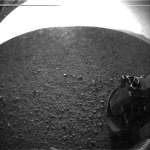 A Wheel on Mars
7.08.2012
A wheel attached to NASA's Curiosity rover is firmly on the martian surface in this early picture from the Mars Science Laboratory mission, captured after a successful landing on August 5, 2012 at 10:32pm (PDT).
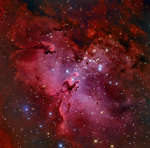 M16 and the Eagle Nebula
7.06.2014
A star cluster around 2 million years young, M16 is surrounded by natal clouds of dust and glowing gas also known as The Eagle Nebula. This beautifully detailed image of the region includes cosmic sculptures made famous in Hubble Space Telescope close-ups of the starforming complex.
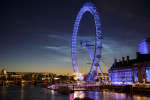 Noctilucent Clouds over London
10.07.2014
This scene from the early morning hours of July 3 looks out across the River Thames from the Westminster Bridge. Part of a luminous timelapse video (vimeo), the frame captures a sight familiar in London, the nighttime glow of the London Eye.
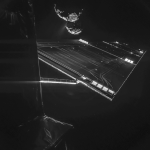 Rosetta s Selfie
16.10.2014
This Rosetta spacecraft selfie was snapped on October 7th. At the time the spacecraft was about 472 million kilometers from planet Earth, but only 16 kilometers from the surface of comet 67P/Churyumov-Gerasimenko. Looming beyond...
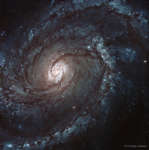 M100: A Grand Design Spiral Galaxy
10.02.2015
Majestic on a truly cosmic scale, M100 is appropriately known as a grand design spiral galaxy. It is a large galaxy of over 100 billion stars with well-defined spiral arms that is similar to our own Milky Way Galaxy.
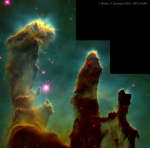 M16: Pillars of Star Creation
24.04.2016
Newborn stars are forming in the Eagle Nebula. This image, taken with the Hubble Space Telescope in 1995, shows evaporating gaseous globules (EGGs) emerging from pillars of molecular hydrogen gas and dust. The giant pillars are light years in length and are so dense that interior gas contracts gravitationally to form stars.
|
January February March April May June July August September October |
|||||||||||||||||||||||||||||||||||||||||||||||||