
|
You entered: dust
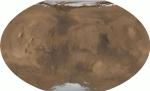 All of Mars
26.06.2001
From pole to pole, from east to west, this is all of Mars. The above picture was digitally reconstructed from over 200 million laser altimeter measurements taken by the Mars Global Surveyor spacecraft currently orbiting Mars.
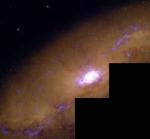 NGC 1808: A Nearby Starburst Galaxy
1.07.1998
NGC 1808 is a galaxy in turmoil. A barred spiral with marked similarities to our home Milky Way Galaxy, NGC 1808 is distinguished by a peculiar nucleus, an unusually warped disk, and strange flows of hydrogen gas out from the central regions.
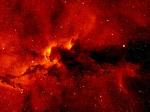 IC 1396 Close Up
30.09.2005
Clouds of glowing hydrogen gas mingle ominously with dark dust lanes in this close-up of IC 1396, an active star forming region some 2,000 light years away in the constellation Cepheus. In this and other similar emission nebulae, energetic ultraviolet light from a hot young star strips electrons from the surrounding hydrogen atoms.
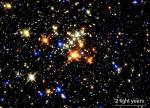 The Quintuplet Star Cluster
21.09.1999
Bright clusters of stars form and disperse near the center of our Galaxy. Four million years ago the Quintuplet Cluster, pictured above, formed and is now slowly dispersing. The Quintuplet Cluster is located within 100 light-years of the Galactic center, and is home to the brightest star yet cataloged in our Galaxy: the Pistol Star.
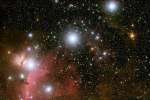 Orion s Belt
9.02.2009
Alnitak, Alnilam, and Mintaka, are the bright bluish stars from east to west (left to right) along the diagonal in this gorgeous cosmic vista. Otherwise known as the Belt of Orion, these three blue supergiant stars are hotter and much more massive than the Sun.
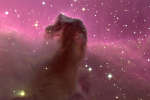 The Horsehead Nebula
21.07.2009
One of the most identifiable nebulae in the sky, the Horsehead Nebula in Orion, is part of a large, dark, molecular cloud. Also known as Barnard 33, the unusual shape was first discovered on a photographic plate in the late 1800s.
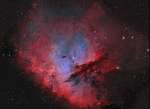 Portrait of NGC 281
25.08.2011
Look through the cosmic cloud cataloged as NGC 281 and it's almost easy to miss stars of open cluster IC 1590. But, formed within the nebula, that cluster's young, massive stars ultimately power the pervasive nebular glow.
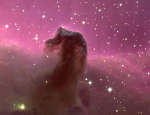 The Horsehead Nebula
21.10.2012
One of the most identifiable nebulae in the sky, the Horsehead Nebula in Orion, is part of a large, dark, molecular cloud. Also known as Barnard 33, the unusual shape was first discovered on a photographic plate in the late 1800s.
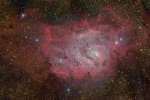 M8: The Lagoon Nebula
17.08.2013
This beautiful cosmic cloud is a popular stop on telescopic tours of the constellation Sagittarius. Eighteenth century cosmic tourist Charles Messier cataloged the bright nebula as M8. Modern day astronomers recognize the Lagoon Nebula as an active stellar nursery about 5,000 light-years distant, in the direction of the center of our Milky Way Galaxy.
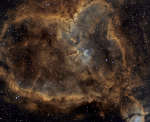 IC 1805: Light from the Heart
14.02.2014
Sprawling across almost 200 light-years, emission nebula IC 1805 is a mix of glowing interstellar gas and dark dust clouds about 7,500 light-years away in the Perseus spiral arm of our galaxy. Stars were born in this region whose nickname, the Heart Nebula, derives from its Valentine's-Day-appropriate shape.
|
January February March April May June July August September October |
|||||||||||||||||||||||||||||||||||||||||||||||||