
|
You entered: dust
 APOD: 2024 April 29 Б Comet, Planet, Moon
29.04.2024
Three bright objects satisfied seasoned stargazers of the western sky just after sunset earlier this month. The most familiar was the Moon, seen on the upper left in a crescent phase. The rest of the Moon was faintly visible by sunlight first reflected by the Earth.
 APOD: 2024 November 26 Б The Sombrero Galaxy from Webb and Hubble
26.11.2024
This floating ring is the size of a galaxy. In fact, it is a galaxy -- or at least part of one: the photogenic Sombrero Galaxy is one of the largest galaxies in the nearby Virgo Cluster of Galaxies.
 APOD: 2026 April 21 Б Three Sky Arches over Snowy Alps
21.04.2026
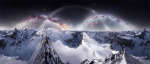
Why are there three arches across the sky instead of two? Last month, after being dropped off by a helicopter at a high mountain peak in the Alps near the Swiss Italian border, an adventurous astrophotographer expected two arches of our Milky Way galaxy to be visible during the night.
 LDN 1295: The Giraffe Nebula
10.09.2026
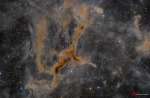
What does this image look like to you? Many see a giraffe facing right, with neck stretched high and long legs mid-stride (but some may see a squirrel instead). The featured image shows LDN 1295, also called the Giraffe Nebula, in the constellation of the mythical queen of Aethiopia (Cassiopeia).
 Reflections on the 1970s
2.10.2003
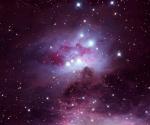
The 1970s are often overlooked. In particular, the beautiful grouping of reflection nebulae NGC 1977, NGC 1975, and NGC 1973 in Orion are often overlooked in favor of the substantial stellar nursery better known as the Orion Nebula.
 Arp 81: 100 Million Years Later
11.12.2003
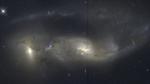
From planet Earth, we view this strongly interacting pair of galaxies, cataloged as Arp 81, as they were only about 100 million years after their mutual closest approach. The havoc wreaked by gravity during...
 The Horsehead Nebula
27.05.2007
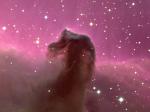
One of the most identifiable nebulae in the sky, the Horsehead Nebula in Orion, is part of a large, dark, molecular cloud. Also known as Barnard 33, the unusual shape was first discovered on a photographic plate in the late 1800s.
 Exploring the Antennae
28.04.2017
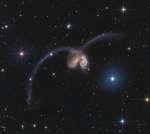
Some 60 million light-years away in the southerly constellation Corvus, two large galaxies are colliding. Stars in the two galaxies, cataloged as NGC 4038 and NGC 4039, very rarely collide in the course of the ponderous cataclysm that lasts for hundreds of millions of years.
 NGC 7814: The Little Sombrero in Pegasus
30.06.2017
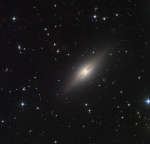
Point your telescope toward the high flying constellation Pegasus and you can find this expanse of Milky Way stars and distant galaxies. Dominated by NGC 7814, the pretty field of view would almost be covered by a full moon.
 Hurricane Season Animated
27.11.2017
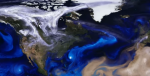
Where do hurricanes go? To better understand dangerous storms, NASA compiled data from several satellites into a supercomputer simulation of this past year's hurricane season. Specifically, the featured video shows how smoke (white), sea salt (blue), and dust (brown) tracked from 2017 August through October across the northern half of Earth's Western Hemisphere.
|
January February March April May June July August September October |
|||||||||||||||||||||||||||||||||||||||||||||||||