
|
You entered: dust
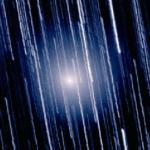 Tempel Tuttle: The Leonid Comet
13.11.1999
Star trails streak this composite time exposure of Comet Tempel-Tuttle recorded by T. Puckett on January 26, 1998. Then passing through the inner solar system on its 33 year orbit around the Sun, Tempel-Tuttle brightened unexpectedly, but binoculars or small telescopes were still required to visually observe it.
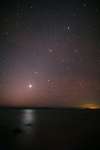 Ecliptic New Zealand
10.07.2010
Four bright celestial beacons and a faint triangle of light follow the plane of the ecliptic as it arcs high through this southern hemisphere night skyscape. Seen on a July winter night from Lake...
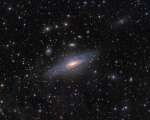 NGC 7331 and Beyond
12.08.2011
Big, beautiful spiral galaxy NGC 7331 is often touted as an analog to our own Milky Way. About 50 million light-years distant in the northern constellation Pegasus, NGC 7331 was recognized early on as a spiral nebula and is actually one of the brighter galaxies not included in Charles Messier's famous 18th century catalog.
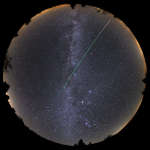 Night of the Long Leonid
22.11.2012
A cosmic grain of sand left the long and colorful trail across this all-sky view. Its grazing impact with planet Earth's atmosphere began at 71 kilometers per second. With the Milky Way stretching...
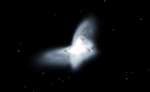 Galaxy Collisions: Simulation vs Observations
14.05.2013
What happens when two galaxies collide? Although it may take over a billion years, such titanic clashes are quite common. Since galaxies are mostly empty space, no internal stars are likely to themselves collide.
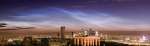 Noctilucent Clouds over Moscow
27.06.2013
This panoramic night scene from June 8 looks out across a Moscow skyline from atop the main building of Lomonosov Moscow State University. Shining in the darkened sky above are widespread noctilucent clouds. From...
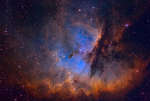 Portrait of NGC 281
4.11.2016
Look through the cosmic cloud cataloged as NGC 281 and you might miss the stars of open cluster IC 1590. Still, formed within the nebula that cluster's young, massive stars ultimately power the pervasive nebular glow.
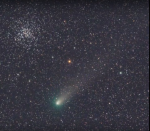 Salt Pepper and Ice
18.09.2018
There's a "camera" comet now moving across the sky. Just a bit too dim to see with the unaided eye, Comet 21P / Giacobini-Zinner has developed a long tail that makes it a good sight for binoculars and sensitive cameras.
 The Light, the Dark, and the Dusty
5.03.2020
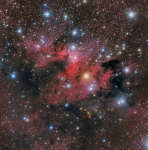
This colorful skyscape spans about four full moons across nebula rich starfields along the plane of our Milky Way Galaxy in the royal northern constellation Cepheus. Near the edge of the region's massive...
 M16: Pillars of Star Creation
6.12.2020
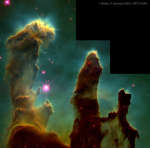
These dark pillars may look destructive, but they are creating stars. This pillar-capturing image of the inside of the Eagle Nebula, taken with the Hubble Space Telescope in 1995, shows evaporating gaseous globules (EGGs) emerging from pillars of molecular hydrogen gas and dust.
|
January February March April May June July August September October |
|||||||||||||||||||||||||||||||||||||||||||||||||