
|
You entered: galaxies
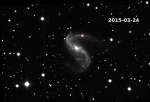 The Rise and Fall of Supernova 2015F
9.02.2016
Sit back and watch a star explode. The actual supernova occurred back when dinosaurs roamed the Earth, but images of the spectacular event began arriving last year. Supernova 2015F was discovered in nearby spiral...
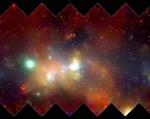 X Ray Milky Way
12.07.2003
If you had x-ray vision, the center regions of our Galaxy would not be hidden from view by the immense cosmic dust clouds opaque to visible light. Instead, the Milky Way toward Sagittarius might look something like this stunning mosaic of images from the orbiting Chandra Observatory.
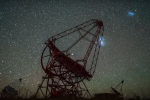 HESS Telescopes Explore the High Energy Sky
8.01.2019
They may look like modern mechanical dinosaurs but they are enormous swiveling eyes that watch the sky. The High Energy Stereoscopic System (H.E.S.S.) Observatory is composed of four 12-meter reflecting-mirror telescopes surrounding a larger telescope housing a 28-meter mirror.
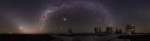 Wonder and Mystery above the Very Large Telescopes
9.05.2011
What's that bright orange dot above the large telescope on the right? Even seasoned sky enthusiasts might ponder the origin of the orange orb seen by scrolling across this panoramic image, taken last December. Perhaps identifying known objects will help.
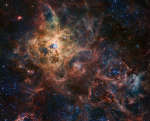 The Tarantula Nebula
26.02.2016
The Tarantula Nebula is more than a thousand light-years in diameter, a giant star forming region within nearby satellite galaxy the Large Magellanic Cloud, about 180 thousand light-years away. The largest, most violent star...
 APOD: 2023 September 6 Б HESS Telescopes Explore the High Energy Sky
6.09.2023
They may look like modern mechanical dinosaurs, but they are enormous swiveling eyes that watch the sky. The High Energy Stereoscopic System (H.E.S.S.) Observatory is composed of four 12-meter reflecting-mirror telescopes surrounding a larger telescope housing a 28-meter mirror.
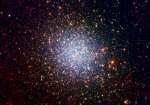 The Giants of Omega Centauri
1.05.2008
Globular star cluster Omega Centauri is some 15,000 light-years away and 150 light-years in diameter. Packed with about 10 million stars, Omega Cen is the largest of 200 or so known globular clusters that roam the halo of our Milky Way galaxy.
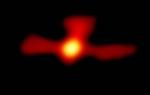 A Galactic Cloud of Antimatter
1.05.1997
The center of our Milky Way Galaxy is full of surprises. Its latest spectacular is a mysterious cloud glowing in gamma rays produced by annihilating antimatter particles! Star Trek fans are all too familiar...
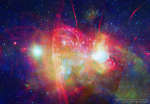 The Galactic Center from Radio to X ray
31.03.2020
In how many ways does the center of our Galaxy glow? This enigmatic region, about 26,000 light years away toward the constellation of the Archer (Sagittarius), glows in every type of light that we can see.
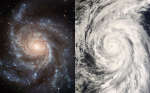 Logarithmic Spirals
17.05.2008
Uncomfortably close Typhoon Rammasun (right) and 25 million light-year distant galaxy M101 don't seem to have much in common. For starters, Rammasun was only a thousand kilometers or so across while M101...
|
January February March April May June July August September October |
|||||||||||||||||||||||||||||||||||||||||||||||||