
|
You entered: galaxies
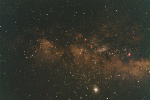 Hale-Bopp, Jupiter, and the Milky Way
23.07.1996
Shining brightly, the mighty Jupiter rules this gorgeous Kodacolor photo of the Milky Way near Sagittarius. Astronomer Bill Keel took the picture earlier this month (July 7) while standing near the summit of Hawaii's Mauna Kea contemplating the sky in the direction of the center of the Galaxy (right of picture center).
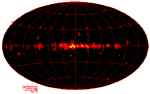 COMPTEL Explores The Radioactive Sky
24.07.1996
Diffuse gas clouds laced with radioactive aluminum atoms (Al26) line the plane of our Milky Way Galaxy! How do we see them? Relying on the Compton Effect, the COMPTEL instrument onboard NASA's immense orbiting Compton Gamma Ray Observatory can "see" the 1.8 million electron Volt gamma rays emitted by the radioactive decay.
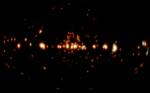 A Mystery in Gamma Rays
24.03.2000
Gamma rays are the most energetic form of light, packing a million or more times the energy of visible light photons. What if you could see gamma rays? If you could, the familiar skyscape...
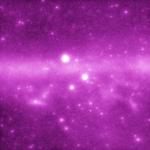 GLAST Gamma Ray Sky Simulation
12.11.1998
This simulated image models the intensities of gamma rays with over 40 million times the energy of visible light, and represents how the sky might appear to the proposed Gamma-ray Large Area Space Telescope (GLAST) after its first year in orbit.
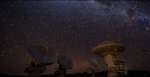 An ALMA Telescope Array Time Lapse
26.05.2014
It is the most expensive and complex ground-based astronomy project ever -- what will it see tonight? The Atacama Large Millimeter Array (ALMA) project consists of 66 dishes, many the size of a small house, situated in the high altitude Atacama Desert in Northern Chile.
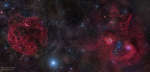 Downtown Auriga
13.02.2014
Rich in star clusters and nebulae, the ancient constellation of Auriga, the Charioteer, rides high in northern winter night skies. Spanning nearly 24 full moons (12 degrees) on the sky, this deep telescopic mosaic view recorded in January shows off some of Auriga's most popular sights for cosmic tourists.
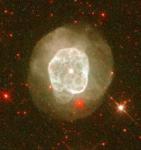 Nebulae For Christmas
25.12.1998
If our Galaxy were a Christmas tree, planetary nebulae would adorn it like colorful lighted ornaments twinkling on a cosmic scale. Glowing shrouds of gas ejected by red giant stars, planetary nebulae like...
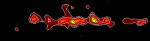 Radioactive Clouds in the Milky Way
29.10.1995
When massive stars explode they create large radioactive blast clouds which expand into interstellar space. As the radioactive elements decay, they produce gamma-rays. Possible locations of these stellar explosions known as supernovae, are indicated by the bright clumps in this map of the central regions of our Milky Way Galaxy.
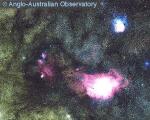 The Sky Towards Sagittarius
7.09.1998
A variety of stars and nebulae can be found towards the constellation of Sagittarius. Dense fields of stars laced with dark lanes of dust crowd this region only a few degrees from the center of our Galaxy.
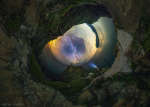 Eye Sky a Dragon
22.09.2019
What do you see when you look into this sky? In the center, in the dark, do you see a night sky filled with stars? Do you see a sunset to the left? Clouds all around? Do you see the central band of our Milky Way Galaxy running down the middle?
|
January February March April May June July August September October |
|||||||||||||||||||||||||||||||||||||||||||||||||