
|
You entered: galaxies
 Wild Duck Open Cluster M11
15.01.1996
Many stars like our Sun were formed in open clusters. The above open cluster, M11, contains thousands of stars and is just over three thousand light years distant. The stars in this cluster all formed together about 150 million years ago. The many bright stars in the cluster appear blue.
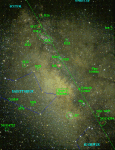 The Annotated Galactic Center
10.11.1997
The sky toward the center of our Galaxy is filled with a wide variety of celestial wonders. Most are visible with only binoculars. Constellations of nearby stars include Sagittarius, Libra, Scorpius, Scutum, and Ophiuchus. Nebulae include Messier Objects M8, M16, M17, M20 and the Pipe Nebula.
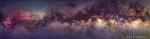 A Milky Way Band
23.02.1999
Most bright stars in our Milky Way Galaxy reside in a disk. Since our Sun also resides in this disk, these stars appear to us as a diffuse band that circles the sky. The above panorama of a southern band of the Milky Way's disk was taken from Australia.
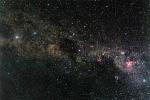 The Milky Way Near the Southern Cross
18.06.2000
This breathtaking patch of sky would be above you were you to stand at the South Pole of the Earth. Just above and to the right of this photograph's center are the four stars that mark the boundaries of the famous Southern Cross.
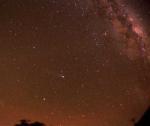 Comet Hyakutake and the Milky Way
17.08.1998
Two years ago, the Great Comet of 1996, Comet Hyakutake, inched across our northern sky during its long orbit around the Sun. Visible above as the bright spot with the faint tail near...
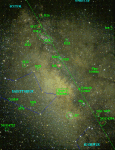 The Annotated Galactic Center
28.12.2001
The sky toward the center of our Galaxy is filled with a wide variety of celestial wonders. Many are easily visible with binoculars. Constellations near the galactic center include Sagittarius, Libra, Scorpius, Scutum, and Ophiuchus. Nebulae include Messier Objects M8, M16, M17, M20 and the Pipe Nebula.
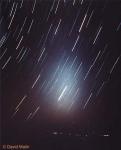 Zodiacal Light
13.06.1999
Sometimes the sky itself seems to glow. Usually, this means you are seeing a cloud reflecting sunlight or moonlight. If the glow appears as a faint band of light running across the whole sky, you are probably seeing the combined light from the billions of stars that compose our Milky Way Galaxy.
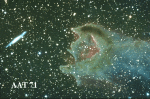 CG4: A Ruptured Cometary Globule
4.10.1995
The odd looking "creature" to the right of center in the above photo is a gas cloud known as a cometary globule. This globule, however, has ruptured. Cometary globules are typically characterized by dusty heads and elongated tails.
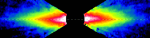 The Dusty Disk of Beta Pic
18.01.1996
This dusty disk, viewed edge on surrounding Beta Pictoris, a star only 50 lightyears distant, may signal the presence of an infant solar system. Beta Pictoris is a young Sun-like star just completing its formative stages.
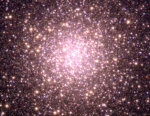 Globular Cluster M3
5.12.1996
This huge ball of stars predates our Sun. Long before mankind evolved, before dinosaurs roamed, and even before our Earth existed, ancient globs of stars condensed and orbited a young Milky Way Galaxy.
|
January February March April May June July August September October |
|||||||||||||||||||||||||||||||||||||||||||||||||