
|
You entered: galaxies
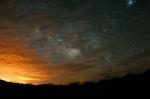 Star Clouds over Arizona
24.04.2006
The clouds in the foreground are much different than the clouds in the background. In the foreground are a photogenic deck of Earth-based water clouds. The long exposure used to create the above photograph makes the light from the left, reflected from Phoenix, Arizona, USA, appear like a sunset.
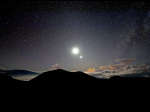 Above the Clouds
23.04.2008
From the windswept peak of Mauna Kea, on the Big Island of Hawaii, your view of the world at night could look like this. At an altitude of about 13,500 feet, the mountain top is silhouetted in the stunning skyscape recorded near dusk in early December of 2005.
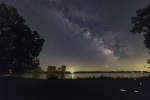 Firefly Trails and the Summer Milky Way
2.07.2016
A camera fixed low to a tripod on a northern summer's eve captured the series of images used in this serene, southern Ontario skyscape. The lakeside view frames our fair galaxy above calm water and the night's quintessential luminous apparitions.
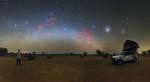 A Kalahari Sky
30.05.2017
You wake up in the Kalahari Desert in Botswana, Africa. You go outside your tent, set up your camera, and take long exposures of the land and sky. What might you see? Besides a lot of blowing dust and the occasional acacia tree, you might catch many sky wonders.
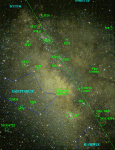 The Annotated Galactic Center
11.09.1999
The sky toward the center of our Galaxy is filled with a wide variety of celestial wonders. Many are easily visible with binoculars. Constellations near the galactic center include Sagittarius, Libra, Scorpius, Scutum, and Ophiuchus. Nebulae include Messier Objects M8, M16, M17, M20 and the Pipe Nebula.
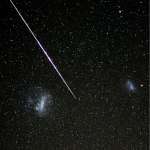 Meteor between the Clouds
20.11.2009
This bright meteor streaked through dark night skies over Sutherland, South Africa on November 15. Potentially part of the annual Leonid meteor shower, its sudden, brilliant appearance, likened to a camera's flash, was captured by chance as it passed between two clouds.
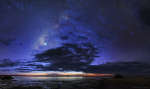 Night Hides the World
7.02.2014
Stars come out as evening twilight fades in this serene skyscape following the Persian proverb "Night hides the world, but reveals a universe." In the scene from last November, the Sun is setting over northern Kenya and the night will soon hide the shores of Lake Turkana, home to many Nile crocodiles.
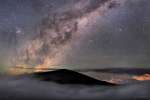 Over the Top
19.06.2014
The central bulge of our Milky Way Galaxy rises above a sea of clouds in this ethereal scene. An echo of the Milky Way's dark dust lanes, the volcanic peak in foreground silhouette is on France's Réunion Island in the southern Indian Ocean.
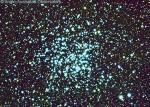 Wild Duck Open Cluster M11
22.10.2000
Many stars like our Sun were formed in open clusters. The above open cluster, M11, contains thousands of stars and is just over three thousand light years distant. The stars in this cluster all formed together about 150 million years ago. The bright young stars in M11 appear blue.
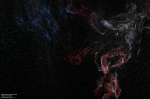 NGC 7841: The Smoke Nebula in Frustriaus
1.11.2013
NGC 7841 is probably known as the Smoke Nebula, found in the modern constellation of Frustriaus, the frustrated astrophotographer. Only a few light-nanoseconds from planet Earth, The Smoke Nebula is not an expanding supernova remnant along the plane of our Milky Way galaxy, though it does look a lot like one.
|
January February March April May June July August September October |
|||||||||||||||||||||||||||||||||||||||||||||||||