
|
You entered: galaxies
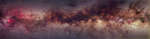 A Milky Way Band
10.07.2011
Most bright stars in our Milky Way Galaxy reside in a disk. Since our Sun also resides in this disk, these stars appear to us as a diffuse band that circles the sky.
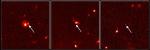 A Distant Destiny
14.01.1998
Watching galaxies recede, observational astronomers of the 20th century discovered an astounding fact - the Universe is expanding. Will it continue to expand forever? The speed of light is finite so looking into the distant Universe is equivalent to looking at the distant past.
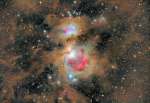 Dust of the Orion Nebula
6.02.2012
What surrounds a hotbed of star formation? In the case of the Orion Nebula -- dust. The entire Orion field, located about 1600 light years away, is inundated with intricate and picturesque filaments of dust.
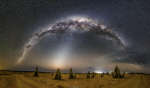 Milky Way and Zodiacal Light over Australian Pinnacles
23.10.2022
What strange world is this? Earth. In the foreground of the featured image are the Pinnacles, unusual rock spires in Nambung National Park in Western Australia. Made of ancient sea shells (limestone), how these human-sized picturesque spires formed remains a topic of research. The picturesque panorama was taken in 2017 September.
 APOD: 2024 September 11 Б A Night Sky over the Tatra Mountains
11.09.2024
A natural border between Slovakia and Poland is the Tatra Mountains. A prominent destination for astrophotographers, the Tatras are the highest mountain range in the Carpathians. In the featured image taken...
 A Sky Portal in New Zealand
29.07.2014
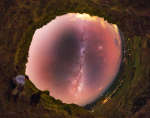
To some, it may look like a portal into the distant universe. To others, it may appear as the eye of a giant. Given poetic license, both are correct. Pictured above is a standard fisheye view of the sky -- but with an unusual projection.
 Mont Blanc, Meteor, and Milky Way
15.09.2018
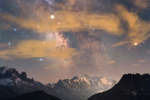
Snowy Mont Blanc is near the center of this atmospheric night skyscape. But high, thin clouds fogged the skies at the photographer's location, looking south toward Europe's highest peak from the southern Swiss Alps.
 Star Cluster Messier 67
9.08.2007
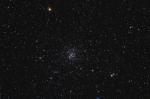
Gathered at the center of this sharp skyview are the stars of Messier 67, one of the oldest known open star clusters. In fact, though open star clusters are usually much younger, the stars...
 Trees, Sky, Galactic Eye
29.06.2010
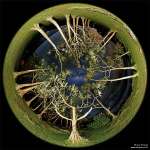
Is beauty in the eye of this beholder? Earlier this month, over RИunion Island in the Indian Ocean, a playful photographer with an eye for the sky took eight images and composed the above intriguing picture.
 Light at the End of the Road
1.09.2016
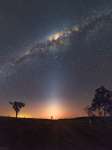
The bright light at the end of this country road is actually a remarkably close conjunction of two planets. After sunset on August 27 brilliant Venus and Jupiter almost appear as a single celestial beacon in the night skyscape taken near Lake Wivenhoe, Queensland, Australia.
|
January February March April May June July August September October |
|||||||||||||||||||||||||||||||||||||||||||||||||