
|
You entered: Voyager
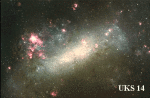 The Large Cloud of Magellan
18.09.1995
Magellan and his crew had plenty of time to study the southern sky during their famous voyage around the world. As a result, two fuzzy cloud like objects, nestled among the southern constellations of Doradus and Tucana are now known as the Clouds of Magellan.
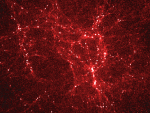 The Early Universe
15.02.1996
What did our universe look like when it was young? To answer this, cosmologists run sophisticated computer programs tracking the locations of millions of particles. The above animated frame is the result of such a calculation and shows how our universe might have looked when it was just a fracton of its current age.
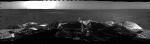 Spirit Pan from Gusev Crater
4.01.2004
After a seven month voyage of nearly 500 million kilometers through interplanetary space, NASA's Spirit Rover has reached the surface of Mars. Scroll right and see a mosaic panorama of Spirit's first images returned from its landing site in Gusev Crater!
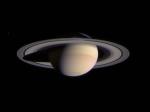 Cassini Closes in on Saturn
29.02.2004
Are they gone? They were not originally predicted to even be there. The mystery revolves around strange shadow-like spokes that appeared on Saturn's large B-ring, the large middle ring in the complex system of particles that orbits Saturn.
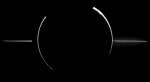 Jupiters Rings Revealed
5.01.2008
Why does Jupiter have rings? Jupiter's rings were discovered in 1979 by the passing Voyager 1 spacecraft, but their origin was a mystery. Data from the Galileo spacecraft that orbited Jupiter from 1995 to 2003 later confirmed that these rings were created by meteoroid impacts on small nearby moons.
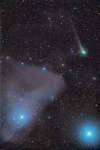 Stardust and Comet Tails
19.08.2022
Heading for its closest approach to the Sun, or perihelion, on December 19 comet C/2017 K2 (PanSTARRS) remains a sight for telescopic observers as it sweeps through planet Earth's skies in the constellation Scorpius.
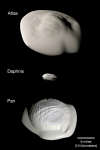 Atlas, Daphnis, and Pan
5.07.2017
Atlas, Daphnis, and Pan are small, inner, ring moons of Saturn, shown at the same scale in this montage of images from the still Saturn-orbiting Cassini spacecraft. In fact, Daphnis was discovered in Cassini images from 2005. Atlas and Pan were first sighted in images from the Voyager 1 and 2 spacecraft.
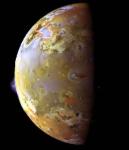 Io: The Prometheus Plume
22.06.2002
Two sulfurous eruptions are visible on Jupiter's volcanic moon Io in this color composite Galileo image. On the left, over Io's limb, a new bluish plume rises about 86 miles above the surface of a volcanic caldera known as Pillan Patera.
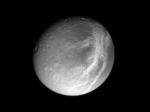 Saturns Moon Dione from Cassini
30.11.2004
What causes the bright streaks on Dione? Recent and likely future images of this unusual moon by the robot Cassini spacecraft now orbiting Saturn might help us find out. The above image was taken at the end of October from a distance of about one million kilometers.
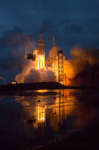 Orion Launch
5.12.2014
Headed for two orbits of planet Earth and a splashdown in the Pacific, Orion blazed into the early morning sky on Friday at 7:05am ET. The spacecraft was launched atop a United Launch Aliance Delta IV Heavy rocket from Cape Canaveral Air Force Station in Florida.
|
January February March April May June July August September October |
|||||||||||||||||||||||||||||||||||||||||||||||||