
|
You entered: Voyager
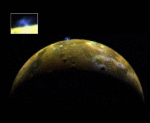 Galileo Views Io Eruption
15.08.1996
Io's surface is active. Geyser-like eruptions from volcanoes on this Jovian moon were seen by both Voyager spacecraft in 1979 and were also spotted this year in late June by Galileo's camera from a distance of about 600,000 miles.
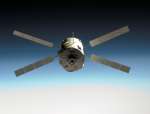 Jules Verne in Orbit
5.04.2008
The bright edge of planet Earth fades into the darkness of space in the background of this view of Jules Verne on an extraordinary voyage. Snapped last Monday, the picture shows the European Space...
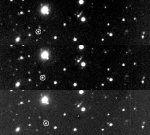 Irregular Moons Discovered Around Uranus
3.11.1997
Where did these two irregular moons of Uranus originate? Last week two previously undiscovered moons of the distant gas planet were confirmed, the first in irregular orbits. All fifteen previously known moons of Uranus are 'regular', circling near the planet's equator. Most of these were discovered by the passing Voyager 2 spacecraft in 1986.
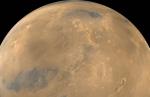 Five to Mars
2.05.2003
Come December 2003 - January 2004, an armada of five new invaders from Earth should arrive on the shores of the Red Planet -- the Japanese ( ISAS) Nozomi orbiter, the European Space Agency's Mars Express orbiter carrying the Beagle 2 lander, and NASA's own two Mars Exploration Rovers.
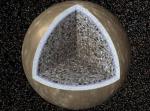 Cutaway Callisto: Ice, Rock, and Ocean
6.11.1998
Cruising past the moons of reigning gas giant Jupiter, Voyager and Galileo have returned tantalizing evidence for a liquid water ocean beneath the surface of Europa. Now researchers are reporting telltale indications that the battered Jovian moon Callisto may also harbor a subsurface
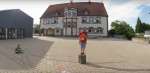 A Day in the Life of a Human Sundial
12.08.2017
Have you ever wanted to be a gnomon? Of course, a gnomon is the tall part of a sundial that casts a shadow. The gnomon's shadow moves as the Sun moves across the sky, indicating time by the shadow's position on the dial face.
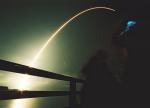 Messenger Launch
14.08.2004
Streaking into the early morning sky on August 3rd, a Delta II rocket launches NASA's Messenger spacecraft on an interplanetary voyage to Mercury. Scheduled to become the first probe to orbit Mercury, Messenger will begin by looping through the inner Solar System in a series of close flybys of planet Earth and Venus.
 The Clipper and the Comet
17.10.2024
NASA's Europa Clipper is now headed toward an ocean world beyond Earth. The large spacecraft is tucked into the payload fairing atop the Falcon Heavy rocket in this photo, taken at Kennedy Space Center the day before the mission's successful October 14 launch.
 APOD: 2025 September 26 Б A SWAN an ATLAS and Mars
26.09.2025
A new visitor to the inner Solar System, comet C/2025 R2 (SWAN) sports a long ion tail extending diagonally across this almost 7 degree wide telescopic field of view recorded on September 21.
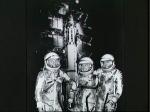 Mercury Astronauts and a Redstone
18.09.1999
Space suited project Mercury astronauts John H. Glenn, Virgil I. Grissom, and Alan B. Shepard Jr. (left to right) are posing in front of a Redstone rocket in this vintage 1961 NASA publicity photo. Project Mercury was the first U.S. program designed to put humans in space.
|
January February March April May June July August September October |
|||||||||||||||||||||||||||||||||||||||||||||||||