
|
You entered: orbit
 The Day After Mars
31.10.2014
October 31, 1938 was the day after Martians encountered planet Earth, and everything was calm. Reports of the invasion were revealed to be part of a Halloween radio drama, the now famous broadcast based on H.G. Wells' scifi novel War of the Worlds.
 Comet 46P Wirtanen
15.11.2018
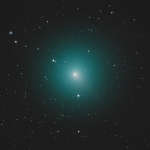
Periodic Comet 46P/Wirtanen is now the brightest comet in the night sky, but too faint to be seen by eye. From dark sky sites it could just become naked-eye visible though, as it's 5.4 year long looping orbit takes it closest to Earth and the Sun in mid December.
 Zodiacal Light and Mars
11.03.2021
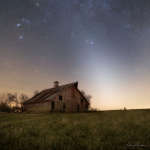
Just after sunset on March 7, a faint band of light still reaches above the western horizon in this serene, rural Illinois, night skyscape. Taken from an old farmstead, the luminous glow is zodiacal light, prominent in the west after sunset during planet Earth's northern hemisphere spring.
 APOD: 2023 June 25 Б Lightning on Jupiter
25.06.2023
Does lightning occur only on Earth? No. Spacecraft in our Solar System have detected lightning on other planets, including Mars, Jupiter and Saturn, and lightning is likely on Venus, Uranus, and Neptune. Lightning is a sudden rush of electrically charged particles from one location to another.
 APOD: 2025 April 1 Б A Double Sunrise from a Partial Eclipse
1.04.2025
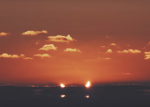
Can the Sun appear to rise twice at the same time? This was just the case a few days ago from Les Escoumins, Quebec, Canada as our Solar System's bright central orb rose just as it was being partially eclipsed by the Moon.
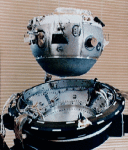 Galileo's Jupiter Probe
7.12.1995
Today, at about 5:00 pm EST, this 750 pound probe from NASA's robot spacecraft Galileo will plummet into Jupiter becoming the first probe to fly through the atmosphere of a gas giant planet.
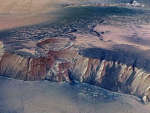 High Cliffs Surrounding Echus Chasma on Mars
23.07.2008
What created this great cliff on Mars? Did giant waterfalls once plummet through its grooves? With a four-kilometer drop, this high cliff surrounding Echus Chasma, near an impressive impact crater, was carved by either water or lava.
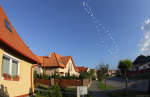 Analemma 2010
31.12.2010
Looking back on the year, have you wondered where the Sun was in the sky each day during 2010 at exacty 9am UT? Of course you have. Search no further for the answer! It was somewhere along this celestial figure 8 curve known as an analemma.
 Cassini Approaches Saturn
15.03.2011
What would it look like to approach Saturn in a spaceship? One doesn't have to just imagine -- the Cassini spacecraft did just this in 2004, recording thousands of images along the way, and thousands more since entering orbit.
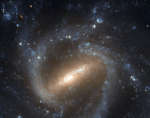 Barred Spiral Galaxy NGC 1073
20.02.2012
Many spiral galaxies have bars across their centers. Even our own Milky Way Galaxy is thought to have a modest central bar. Prominently barred spiral galaxy NGC 1073, pictured above, was captured in spectacular detail in this recently released image taken by the orbiting Hubble Space Telescope.
|
January February March April May June July August September |
|||||||||||||||||||||||||||||||||||||||||||||||||