
|
You entered: orbit
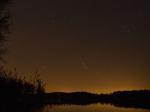 A Leonid Meteor Over Sweden
20.11.2006
This past weekend, small remnant bits of a distant comet lit up the skies over much of planet Earth. Incoming reports, however, have this year's Leonid meteor shower as less active than Leonid meteor showers a few years ago.
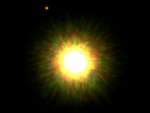 Companion of a Young Sun like Star
19.09.2008
Located just 500 light-years away toward the constellation Scorpius, this star is only slightly less massive and a little cooler than the Sun. But it is much younger, a few million years old compared to the middle-aged Sun's 5 billion years.
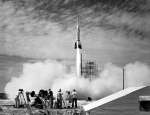 The First Rocket Launch from Cape Canaveral
18.07.2015
A new chapter in space flight began this week in 1950 July with the launch of the first rocket from Cape Canaveral, Florida: the Bumper V-2. Shown above, the Bumper V-2 was an ambitious two-stage rocket program that topped a V-2 missile base with a WAC Corporal rocket.
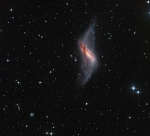 Polar Ring Galaxy NGC 660
16.02.2017
NGC 660 is featured in this cosmic snapshot. Over 40 million light-years away and swimming within the boundaries of the constellation Pisces, NGC 660's peculiar appearance marks it as a polar ring galaxy.
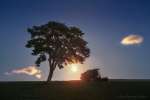 A Harvest Moon
12.09.2019
Famed in festival, story, and song the best known full moon is the Harvest Moon. For northern hemisphere dwellers that's a traditional name of the closest full moon to the September equinox. In most North America time zones this year's Harvest Moon will officially rise on Friday, September 13.
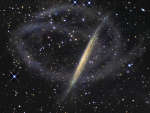 The Star Streams of NGC 5907
15.11.2019
Grand tidal streams of stars seem to surround galaxy NGC 5907. The arcing structures form tenuous loops extending more than 150,000 light-years from the narrow, edge-on spiral, also known as the Splinter or Knife Edge Galaxy.
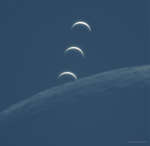 Moon Occults Venus
20.06.2020
It may look like Earthrise, but it's actually Venus-set. Just after sunrise two days ago, both the Moon and Venus also rose. But then the Moon overtook Venus. In the featured image sequence centered on the Moon, Venus is shown increasingly angularly close to the Moon.
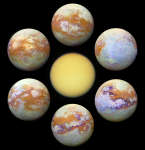 APOD: 2026 May 2 Б Seeing Titan
1.05.2026
Shrouded in a thick atmosphere, the surface of Saturn's largest moon, Titan, is really hard to see. Small particles suspended in Titan's upper atmosphere cause an almost impenetrable haze, strongly scattering light at visible wavelengths and hiding surface features from prying eyes.
 Galactic Center Flicker Indicates Black Hole
10.09.2001
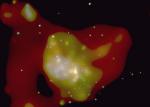
Why would the center of our Galaxy flicker? Many astronomers believe the only credible answer involves a black hole. During observations of Sagittarius A* with the orbiting Chandra X-ray Observatory, the bright X-ray source at the very center of our Milky Way brightened dramatically for a few minutes.
 THEMIS of Mars
1.11.2001
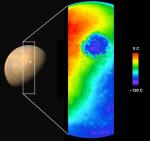
Not an ancient Greek goddess, THEMIS is modern acronese for THermal EMission Imaging System. Above is this remarkable instrument's premier infrared image of Mars, from the newly orbiting Mars Odyssey spacecraft. Taken...
|
January February March April May June July August September |
|||||||||||||||||||||||||||||||||||||||||||||||||