
|
You entered: Earth
 Sunrise Shadows in the Sky
21.09.2024
The defining astronomical moment of this September's equinox is at 12:44 UTC on September 22, when the Sun crosses the celestial equator moving south in its yearly journey through planet Earth's sky.
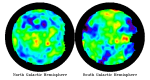 COBE Hotspots:The Oldest Structures Known
9.03.1997
Above are two images of the microwave sky, north and south of our galaxy's equator, based on data from NASA's COsmic Background Explorer (COBE) satellite. After computer processing to remove contributions from nearby objects and the effects of the earth's motion, they show "spots".
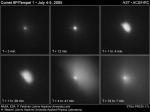 Deep Impact on Comet Tempel 1 from Hubble
18.07.2005
It was a human-made event visible across the Solar System. At the direction of terrestrial scientists, a refrigerator-sized probe from the Deep Impact mission struck Comet Tempel 1 on July 4 at over 35,000 kilometers per hour.
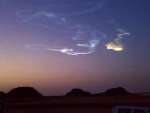 On the Trail of 2008 TC3
8.11.2008
On October 7, the early dawn over northern Sudan revealed this twisted, high altitude trail. Captured in a video frame, the long-lasting persistent train is from the impact of a small asteroid cataloged as 2008 TC3.
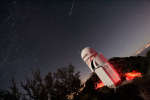 Geminids over Kit Peak
16.12.2010
Two large telescope domes stand in the foreground of this night sky view from Kitt Peak National Observatory, near Tucson, Arizona, USA. The dramatic scene was recorded early Tuesday morning, near the peak of December's Geminid Meteor Shower.
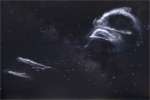 Rocket Trails in the Milky Way
29.03.2012
On March 27, five sounding rockets leapt into early morning skies from NASA's Wallops Flight Facility in Virginia. Part of the Anomalous Transport Rocket EXperiment (ATREX), begining at 4:58 am EDT the rockets launched consecutively at 80 second intervals.
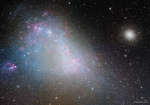 The Small Cloud of Magellan
5.01.2021
What is the Small Magellanic Cloud? It has turned out to be a galaxy. People who have wondered about this little fuzzy patch in the southern sky included Portuguese navigator Ferdinand Magellan...
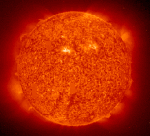 A Winter Solstice
21.12.1997
Today is the Winter Solstice, the shortest day of the year in the Northern Hemisphere. The yearly cycle of Seasons on planet Earth once again finds the Sun at its lowest point in the Northern Sky.
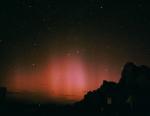 Aurora In West Texas Skies
15.09.2000
The aurora borealis, or northern lights, are not a common sight in the southwestern United States. But a strong solar coronal mass ejection in early August triggered geomagnetic storms and aurora which were widely reported, even under west Texas skies.
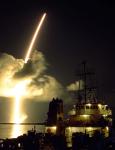 Cassini To Venus
16.10.1997
NASA's Saturn Explorer Cassini with ESA's Titan Probe Huygens attached successfully rocketed into the skies early yesterday morning. The mighty Titan 4B Centaur rocket is seen here across the water gracefully arcing away from Launch Complex 40 at Cape Canaveral Air Station.
|
January February March April May June July August September October |
|||||||||||||||||||||||||||||||||||||||||||||||||