
|
You entered: Earth
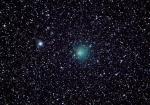 Comet Encke Returns
23.12.2003
It's back. Every 3.3 years, Comet Encke swoops back into our inner Solar System. First officially discovered in 1786, Comet Encke is on its 59 th documented return, making it one of the best-studied comets on the sky.
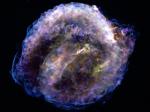 Keplers Supernova Remnant in X Rays
16.01.2007
What caused this mess? Some type of star exploded to create the unusually shaped nebula known as Kepler's supernova remnant, but which type? Light from the stellar explosion that created this energized cosmic cloud was first seen on planet Earth in October 1604, a mere four hundred years ago.
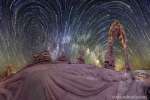 Warped Sky: Star Trails over Arches National Park
17.03.2014
What's happened to the sky? A time warp, of sorts, and a digital space warp too. The time warp occurs because this image captured in a single frame a two and a half hour exposure of the night sky. As a result, prominent star trails are visible.
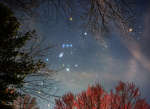 Orion Spring
25.03.2015
As spring comes to planet Earth's northern hemisphere, familiar winter constellation Orion sets in early evening skies and budding trees frame the Hunter's stars. The yellowish hue of cool red supergiant Alpha Orionis, the great star Betelgeuse, mingles with the branches at the top of this colorful skyscape.
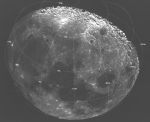 North to the Moon's Pole
22.06.1996
This image is from the voyage of the intrepid Galileo spacecraft as it passed above the Moon's north pole on its long journey to Jupiter. It was made over 60 years after Admiral Byrd became the first to fly over the Earth's north pole.
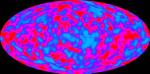 COBE Hotspots: The Oldest Structures Known
7.02.1998
Above is a microwave image of the entire sky. The plane of our galaxy runs horizontally through the center. This historic all-sky map is based on the first two years of data from NASA's COsmic Background Explorer (COBE) satellite.
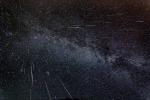 Raining Perseids
12.08.2007
Tonight is a good night to see meteors. Comet dust will rain down on planet Earth, streaking through dark skies in the annual Perseid meteor shower. While enjoying the anticipated space weather, astronomer Fred...
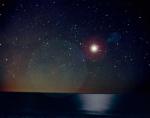 1006 AD: Supernova in the Sky
28.03.2003
A new star, likely the brightest supernova in recorded human history, appeared in planet Earth's sky in the year 1006 AD. The expanding debris cloud from the stellar explosion is still visible to modern astronomers, but what did the supernova look like in 1006?
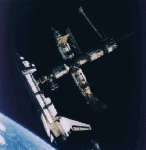 The Space Shuttle Docks with Mir
17.12.1995
Hundreds of kilometers above the Earth's surface, the United States Space Shuttle Atlantis docks with the Russian Space Station Mir. The photograph was taken by Nikolai Budarin from a Russian Soyuz spacecraft on July 4, 1995.
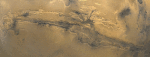 The Grand Canyon of Mars
20.07.1995
The Mariner Valley, also known as the Valles Marineris canyon system, appears in this mosaic of images from NASA's Viking spacecraft as a huge gouge across the red planet. This "Grand Canyon" of Mars is about 2500 miles long and up to 4 miles deep.
|
January February March April May June July August September October |
|||||||||||||||||||||||||||||||||||||||||||||||||