
|
You entered: dark
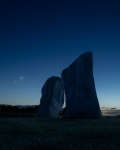 APOD: 2026 June 12 Б Venus and Jupiter: Conjunction from Avebury
12.06.2026
To see Venus and Jupiter together this month, you won't need binoculars or even a telescope. Just look up after sunset and you'll find them emerging as the sky grows dark near the western horizon.
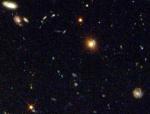 The Hubble Deep Field South
14.12.1998
Among the faintest objects are some of the most unusual objects. The Hubble Deep Field South was released after much anticipation earlier this month, delivering a unique view of some of the most distant parts of our universe. Part of this field is shown above.
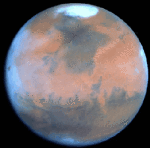 A Halloween Invasion from Mars
31.10.1995
Orson Welles became an instant legend on Halloween in 1938 for his radio dramatization of H.G. Wells' "War of the Worlds". Some listeners who did not realize it was a theatrical production were driven to near panic by this fictional account of invaders from Mars.
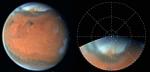 The Martian Spring
4.11.1996
As spring comes to the northern latitudes of Mars, increased solar heating brings warmth and a change in the weather. The winds produced by the large temperature differences between the receding polar...
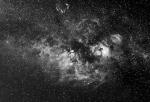 Cygnus Nebulosities
23.10.2003
Looking toward the constellation Cygnus, a stunning and complex region of nebulae strewn along the plane of our Milky Way galaxy is revealed in this unique wide-angle sky view. Recorded with a filter designed...
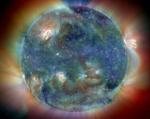 Solstice Celebration
20.06.2004
Season's greetings! Today or tomorrow, depending on your time zone, the Sun reaches its northernmost point in planet Earth's sky marking a season change and the first solstice of the year 2004. In celebration, consider this delightfully detailed, brightly colored image of the active Sun.
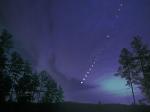 A Total Lunar Eclipse Over North Carolina
26.08.2007
This coming Tuesday, our Moon will appear to disappear. A similar total lunar eclipse is seen above in a time lapse image captured in 2003 over North Carolina, USA. As the Earth moves between the Moon and the Sun, the Earth's shadow fell on the moon, making it quite dark.
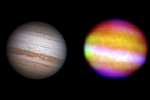 Jupiter from the Stratosphere
3.06.2010
SOFIA, the Stratospheric Observatory for Infrared Astronomy, captured its "first light" images on May 26, from an altitude of 35,000 feet. While flying above most of planet Earth's infrared-absorbing water vapor, SOFIA's premier infrared views of the cosmos included this remarkable false-color image (right panel) of Jupiter.
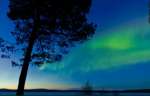 Time Lapse Auroras Over Norway
29.12.2013
Sometimes, after your eyes adapt to the dark, a spectacular sky appears. Such was the case in 2011 March when one of the largest auroral displays in recent years appeared over northern locations like the border between Norway and Russia.
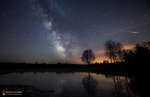 Halley Dust and Milky Way
9.05.2014
The early morning hours of May 6 were moonless when grains of cosmic dust streaked through dark skies. Swept up as planet Earth plows through dusty debris streams left behind periodic Comet Halley, the annual meteor shower is known as the Eta Aquarids.
|
January February March April May June July August September |
|||||||||||||||||||||||||||||||||||||||||||||||||