
|
You entered: space
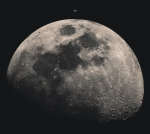 APOD: 2026 April 15 Б The ISS Transits the Moon
15.04.2026
Nope, that is not an alien spaceship landing on the Moon! This is an image of the International Space Station (ISS) as it begins to transit in front of the Moon. The ISS is in low-Earth orbit (LEO) where it wizzes around the Earth every 90 minutes.
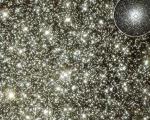 Unusual Flashes Toward Globular Cluster M22
3.07.2001
What is causing the unusual flashes behind globular cluster M22? This teaming ball of stars is the brightest globular cluster visible in Earth's northern hemisphere. M22, shown in full in the inset, spans about 50 light years away and lies 8500 light-years toward the constellation of Sagittarius.
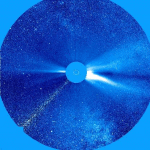 Solar Wind And Milky Way
4.03.1997
The Sun is bright, so bright that it overwhelms the light from other stars even for most satellite-borne telescopes. But LASCO, a coronograph onboard the space-based SOHO Observatory, uses occulting disks to block the intense solar light and examine the tenuous, hot gases millions of miles above the Sun's surface.
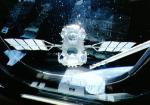 Boosting Compton
6.06.1997
Even great observatories need a boost from time to time -- including the orbiting Compton Gamma-Ray Observatory. Sparkling reflections and the bright limb of the Earth are visible in this 1991 window view of Compton's release into orbit by the crew of the Space Shuttle Atlantis.
 Windblown N44F
19.08.2004
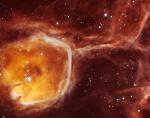
A fast and powerful wind from a hot young star has created this stunning bubble-shaped nebula poised on the end of a bright filament of hydrogen gas. Cataloged as N44F, the cosmic windblown bubble is seen at the left of this Hubble Space Telescope image.
 Martian Dust Devil Trails
17.03.2000
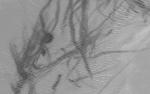
Who's been marking up Mars? This portion of a recent high-resolution picture from the orbiting Mars Global Surveyor spacecraft shows twisting dark trails criss-crossing a relatively flat rippled region about 3 kilometers wide on the martian surface.
 Mars Weather Watch
16.08.1999
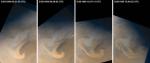
Mars may be a cold, dry planet but its weather is dynamic. On June 30, wide angle cameras on board the Mars Global Surveyor (MGS) spacecraft watched the development of this large scale storm system above Mars' north polar area.
 Arp 272
30.04.2008
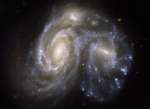
Linking spiral arms, two large colliding galaxies are featured in this Hubble Space Telescope view, part of a series of cosmic snapshots released to celebrate the Hubble's 18th anniversary. Recorded in astronomer Halton Arp's Atlas of Peculiar Galaxies as Arp 272, the pair is otherwise known as NGC 6050 and IC 1179.
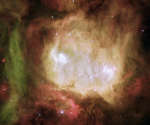 Halloween and the Ghost Head Nebula
31.10.2010
Halloween's origin is ancient and astronomical. Since the fifth century BC, Halloween has been celebrated as a cross-quarter day, a day halfway between an equinox (equal day / equal night) and a solstice (minimum day / maximum night in the northern hemisphere). With a modern calendar, however, the real cross-quarter day will occur next week.
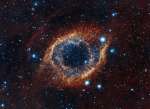 The Helix Nebula from the VISTA Telescope
31.01.2012
Will our Sun look like this one day? The Helix Nebula is one of brightest and closest examples of a planetary nebula, a gas cloud created at the end of the life of a Sun-like star.
|
January February March April May June July August September October |
|||||||||||||||||||||||||||||||||||||||||||||||||