
|
You entered: space
 Pandora s Cluster of Galaxies
9.06.2023
This deep field mosaicked image presents a stunning view of galaxy cluster Abell 2744 from the James Webb Space Telescope's NIRCam. Also dubbed Pandora's Cluster, Abell 2744 itself appears to be a ponderous merger of three different massive galaxy clusters some 3.5 billion light-years away toward the constellation Sculptor.
 Herbig Haro 24
28.05.2025
This might look like a double-bladed lightsaber, but these two cosmic jets actually beam outward from a newborn star in a galaxy near you. Constructed from Hubble Space Telescope image data, the stunning scene...
 APOD: 2026 May 25 Б Thackerays Globules
25.05.2026
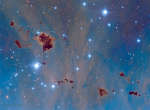
What are these strange space globs? Situated in rich star fields and glowing hydrogen gas, these opaque clouds of interstellar dust and gas are so large they might be able to form stars. Their...
 The Center of Centaurus A
1.10.2000
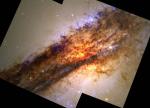
A fantastic jumble of young blue star clusters, gigantic glowing gas clouds, and imposing dark dust lanes surrounds the central region of the active galaxy Centaurus A. This mosaic of Hubble Space Telescope images taken in blue, green, and red light has been processed to present a natural color picture of this cosmic maelstrom.
 Comet LINEAR Disperses
8.08.2000
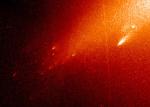
What's happened to the nucleus of Comet LINEAR? The brightest comet this year has unexpectedly broken up into many smaller pieces. The break-up occurred on or about July 25 and was noted by many astronomers around the world with particularly pioneering work by Mark Kidger (IAC).
 Halloween and the Ghost Head Nebula
31.10.2001
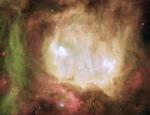
Halloween's origin is ancient and astronomical. Since the fifth century BC, Halloween has been celebrated as a cross-quarter day, a day halfway between an equinox (equal day / equal night) and a solstice (minimum day / maximum night in the northern hemisphere). With our modern calendar, however, the real cross-quarter day will occur next week.
 Asteroid 1998 KY26
19.09.2002
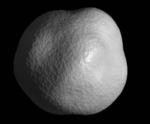
A day is just under 11 minutes long on 1998 KY26, a 30 meter wide, fast-spinning, water-rich asteroid. This computer simulated view of its lumpy surface has a resolution of about 3 meters and is based on radar and optical observations (click on the image for a series of surface views).
 IC 5067: A Piece of the Pelican
19.10.2007
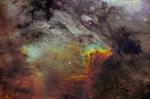
(xxxedit and linkxxx) The prominent ridge of emission featured in this dramatic skyscape is cataloged as IC 5067. Part of a larger emission nebula with a distinctive shape, popularly called The Pelican Nebula, the ridge spans about 10 light-years following the curve of the cosmic pelican's head and neck.
 NGC 4452: An Extremely Thin Galaxy
9.11.2010
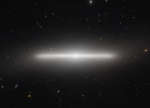
Why is there a line segment on the sky? In one of the more precise alignments known in the universe, what is pictured above is actually a disk galaxy being seen almost perfectly edge on. The image from the Hubble Space Telescope is a spectacular visual reminder of just how thin disk galaxies can be.
 Bright Planetary Nebula NGC 7027 from Hubble
26.08.2013
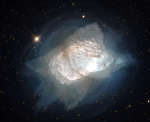
It is one of the brightest planetary nebulae on the sky -- what should it be named? First discovered in 1878, nebula NGC 7027 can be seen toward the constellation of the Swan (Cygnus) with a standard backyard telescope.
|
January February March April May June July August September October |
|||||||||||||||||||||||||||||||||||||||||||||||||