
|
You entered: space
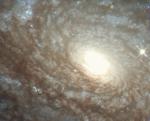 NGC 4414: A Flocculent Spiral Galaxy
3.04.2002
How much mass do flocculent spirals hide? The above true color image of flocculent spiral galaxy NGC 4414 was taken with the Hubble Space Telescope to help answer this question. Flocculent spirals -- galaxies without well defined spiral arms -- are a quite common form of galaxy, and NGC 4414 is one of the closest.
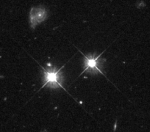 A Milestone Quasar
18.08.1996
Here is a rather typical quasar. But since quasars are so unusual it is quite atypical of most familiar objects. Of the two bright objects in the center of this photo, the quasar is on the left.
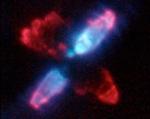 Shells in the Egg Nebula
20.05.1997
The Egg Nebula is taking a beating. Like a baby chick pecking its way out of an egg, the star in the center of the Egg Nebula is casting away shells of gas and dust as it slowly transforms itself into a white dwarf star.
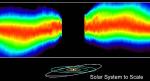 Closer To Beta Pic
21.01.1998
What did our Solar System look like as the planets were forming? Since the 1980s, astronomers have been pointing toward Beta Pictoris, a young, sun-like star a mere 50 light-years distant, as a likely example. Beta Pic is surrounded by a disk of dust which we view nearly edge-on.
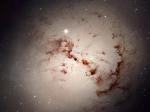 NGC 1316: After Galaxies Collide
4.04.2005
How did this strange-looking galaxy form? Astronomers turn detectives when trying to figure out the cause of unusual jumbles of stars, gas, and dust like NGC 1316. A preliminary inspection indicates that NGC 1316 is an enormous elliptical galaxy that includes dark dust lanes usually found in a spiral.
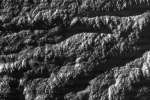 Seventeen Hundred Kilometers Above Enceladus
4.11.2008
Above is one of the closest pictures yet obtained of Saturn's ice-spewing moon Enceladus. The image was taken from about 1,700 kilometers up as the robotic Cassini spacecraft zoomed by the fractured ice ball last week.
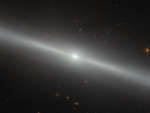 NGC 4762: A Galaxy on the Edge
4.11.2014
Why is there a bright line on the sky? What is pictured above is actually a disk galaxy being seen almost perfectly edge on. The image from the Hubble Space Telescope is a spectacular visual reminder of just how thin disk galaxies can be.
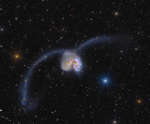 Exploring the Antennae
11.02.2015
Some 60 million light-years away in the southerly constellation Corvus, two large galaxies are colliding. The stars in the two galaxies, cataloged as NGC 4038 and NGC 4039, very rarely collide in the course of the ponderous cataclysm, lasting hundreds of millions of years.
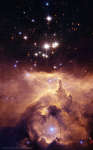 NGC 6357: Cathedral to Massive Stars
26.03.2016
How massive can a normal star be? Estimates made from distance, brightness and standard solar models had given one star in the open cluster Pismis 24 over 200 times the mass of our Sun, making it one of the most massive stars known.
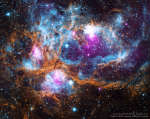 NGC 6357: Stellar Wonderland
25.12.2016
For reasons unknown, NGC 6357 is forming some of the most massive stars ever discovered. This complex wonderland of star formation consists of numerous filaments of dust and gas surrounding huge cavities of massive star clusters. The intricate patterns are caused by complex interactions between interstellar winds, radiation pressures, magnetic fields, and gravity.
|
January February March April May June July |
|||||||||||||||||||||||||||||||||||||||||||||||||