
|
You entered: space
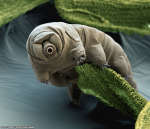 Tardigrade in Moss
26.03.2017
Is this an alien? Probably not, but of all the animals on Earth, the tardigrade might be the best candidate. That's because tardigrades are known to be able to go for decades without...
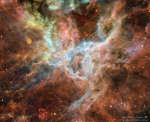 In the Heart of the Tarantula Nebula
20.05.2018
In the heart of monstrous Tarantula Nebula lies huge bubbles of energetic gas, long filaments of dark dust, and unusually massive stars. In the center of this heart, is a knot of stars so dense that it was once thought to be a single star.
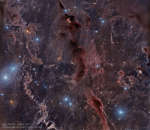 Dark Nebulas across Taurus
26.06.2018
Sometimes even the dark dust of interstellar space has a serene beauty. One such place occurs toward the constellation of Taurus. The filaments featured here can be found on the sky between the Pleiades star cluster and the California Nebula.
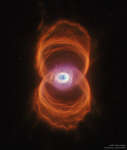 MyCn 18: The Engraved Hourglass Planetary Nebula
29.09.2019
Do you see the hourglass shape -- or does it see you? If you can picture it, the rings of MyCn 18 trace the outline of an hourglass -- although one with an unusual eye in its center. Either way, the sands of time are running out for the central star of this hourglass-shaped planetary nebula.
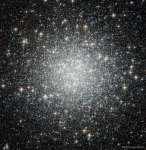 Blue Straggler Stars in Globular Cluster M53
7.02.2021
If our Sun were part of this star cluster, the night sky would glow like a jewel box of bright stars. This cluster, known as M53 and cataloged as NGC 5024, is one of about 250 globular clusters that survive in our Galaxy.
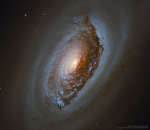 M64: The Evil Eye Galaxy
29.03.2021
Who knows what evil lurks in the eyes of galaxies? The Hubble knows -- or in the case of spiral galaxy M64 -- is helping to find out. Messier 64, also known as the Evil...
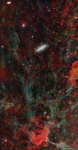 The Deep Sky Toward Andromeda
8.09.2021
What surrounds the Andromeda galaxy? Out in space, Andromeda (M31) is closely surrounded by several small satellite galaxies, and further out it is part of the Local Group of Galaxies -- of which our Milky Way galaxy is also a member.
 Rubin's Galaxy
13.06.2025
In this Hubble Space Telescope image the bright, spiky stars lie in the foreground toward the heroic northern constellation Perseus and well within our own Milky Way galaxy. In sharp focus beyond is UGC 2885, a giant spiral galaxy about 232 million light-years distant.
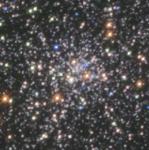 At The Core Of M15
17.01.1998
Densely packed stars in the core of the globular cluster M15 are shown in this Hubble Space Telescope (HST) image. The star colors roughly indicate their temperatures - hot stars appear blue, cooler stars look reddish-orange.
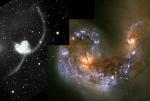 The Antennae Galaxies
22.10.1997
A ground-based telescopic view (left) of the collision between the galaxies NGC4038 and NGC4039 reveals long arcing insect-like "antennae" of luminous matter flung from the scene of the accident. Investigators using the Hubble Space...
|
January February March April May June July August September October |
|||||||||||||||||||||||||||||||||||||||||||||||||