
|
You entered: distance
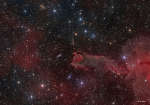 CG4: A Ruptured Cometary Globule
26.07.2021
Can a gas cloud grab a galaxy? It's not even close. The "claw" of this odd looking "creature" in the featured photo is a gas cloud known as a cometary globule. This globule, however, has ruptured. Cometary globules are typically characterized by dusty heads and elongated tails.
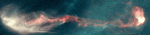 HH-47 Star Jet
12.10.1995
The star masked by a dust cloud at the left of the above photo is expelling an energetic beam of charged particles into interstellar space. This jet, moving from left to right, has burrowed through much interstellar material, and now expands out into the interstellar space.
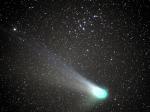 Comet NEAT and the Beehive Cluster
17.06.2004
To the unaided eye, they appeared as similar fuzzy patches. But when a bright comet passed in front of a bright star cluster last month, binoculars and cameras were able to show off their marked differences in dramatic fashion.
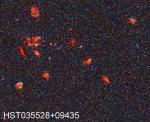 A Cluster Too Far
8.09.1998
Why is this galaxy cluster so red? Nearby clusters have galaxies with colors that are much more yellow and blue. A leading explanation is that this cluster of galaxies lies so far across our universe (z~1) that cosmological time dilation significantly reddens the light.
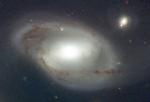 The Galaxy and the Quasar
7.10.2002
Is the galaxy in the center connected to the quasar on the upper right? Disagreements about systems like this have raged for decades and have been used to challenge the foundations of modern cosmology.
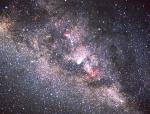 Comet Halley and the Milky Way
3.10.1997
Comet Halley was photographed superposed in front of the disk of our Milky Way Galaxy in 1986 by the Kuiper Airborne Observatory. Comet Halley is the bright white streak near this photograph's center. Comet Halley is the most famous comet in history, and returns to the inner Solar System every 76 years.
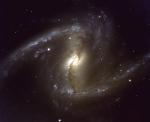 NGC 1365: A Nearby Barred Spiral Galaxy
24.06.1999
Many spiral galaxies have bars across their centers. Even our own Milky Way Galaxy is thought to have a bar, but perhaps not so prominent as the one in NGC 1365, shown above. The persistence and motion of the bar imply relatively massive spiral arms.
 Full Observatory Moon
27.01.2024
A popular name for January's full moon in the northern hemisphere is the Full Wolf Moon. As the new year's first full moon, it rises over Las Campanas Observatory in this dramatic Earth-and-moonscape. Peering from the foreground like astronomical eyes are the observatory's twin 6.5 meter diameter Magellan telescopes.
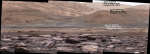 Curiosity Surveys Lower Mount Sharp on Mars
28.12.2016
If you could stand on Mars -- what might you see? If you were the Curiosity rover, then just last month you would have contemplated the featured image -- a breathtaking panorama of the lower portion of Mount Sharp. The colors have been adjusted to mimic lighting familiar to Earthlings.
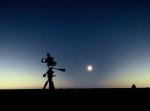 Shadow Cone of a Total Solar Eclipse
6.01.2003
Sometimes, during a total eclipse of the Sun, a strange shadow of darkness can be seen stretching off into the distance. Called a shadow cone, they are visible because the Earth's atmosphere is not completely transparent, scattering sunlight and hence appearing blue during the day.
|
January February March April May June July August September October |
|||||||||||||||||||||||||||||||||||||||||||||||||