
|
You entered: distance
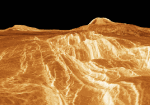 A View from Venus: Rift Valley
24.06.1996
Color information from the Soviet Venera landers and radar data from the Magellan spacecraft were used to construct this striking perspective view of the Venusian landscape. (In this computer generated image, the vertical scale has been exagerated.) In the foreground is the edge of a rift valley created by faulting in the crust of Venus.
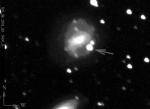 A Gamma Ray Burst Supernova
8.05.1998
Did a gamma-ray burst precede this supernova? This intriguing suggestion came to light yesterday with the discovery of an evolving supernova that is potentially coincident with the position of gamma-ray burst GRB 980425, which occurred just two weeks ago. If true, this would tie together the two most violent phenomena known in the universe.
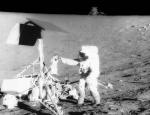 Apollo 12 Visits Surveyor 3
5.10.2003
Apollo 12 was the second mission to land humans on the Moon. The landing site was picked to be near the location of Surveyor 3, a robot spacecraft that had landed on the Moon three years earlier.
 A Mars Panorama from the Spirit Rover
14.01.2004
If you could stand on Mars -- what would you see? Scrolling right will reveal a full color 360-degree panoramic view from NASA's Spirit Rover that landed on Mars just 10 days ago. The image is a digital mosaic from the panoramic camera that shows the view in every direction.
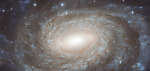 NGC 6384: Spiral Beyond the Stars
22.03.2011
The universe is filled with galaxies. But to see them astronomers must look out beyond the stars of our galaxy, the Milky Way. For example, consider this colorful telescopic view of spiral galaxy NGC 6384, about 80 million light-years away in the direction of the constellation Ophiuchus.
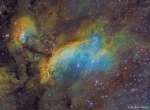 IC 4628: The Prawn Nebula
4.07.2016
South of Antares, in the tail of the nebula-rich constellation Scorpius, lies emission nebula IC 4628. Nearby hot, massive stars, millions of years young, radiate the nebula with invisible ultraviolet light, stripping electrons from atoms. The electrons eventually recombine with the atoms to produce the visible nebular glow, dominated by the red emission of hydrogen.
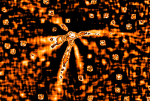 Seven Jets from Comet Hale-Bopp
13.11.1996
Comet Hale-Bopp is turning out to be quite unusual. One reason is the great amount of jet activity at such a large distance from the Sun. In the above false-color image, no less than seven jets can be seen emanating from Hale-Bopp's coma.
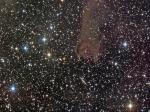 CG4: A Ruptured Cometary Globule
6.08.2007
Can a gas cloud eat a galaxy? It's not even close. The odd looking "creature" or "hand" extending down from the top of the above photo is a gas cloud known as a cometary globule. This globule, however, has ruptured. Cometary globules are typically characterized by dusty heads and elongated tails.
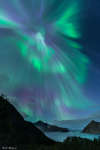 Auroral Corona over Norway
14.10.2014
Higher than the highest mountain lies the realm of the aurora. Auroras rarely reach below 60 kilometers, and can range up to 1000 kilometers. Aurora light results from energetic electrons and protons striking atoms and molecules in the Earth's atmosphere.
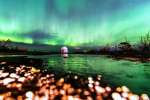 Aurora: The Frog's View
6.10.2018
What does an aurora look like to a frog? "Awesome!" is the likely answer, suggested by this imaginative snapshot taken on October 3rd from Kiruna, Sweden. Frequented by apparitions of the northern lights, Kiruna...
|
January February March April May June July August September October |
|||||||||||||||||||||||||||||||||||||||||||||||||