
|
You entered: clouds
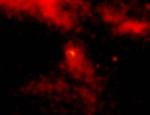 Pulsar Wind in the Vela Nebula
19.07.2001
The Vela pulsar was born 10,000 years ago at the center of a supernova -- an exploding star. In this Chandra Observatory x-ray image, the pulsar still produces a glowing nebula at the heart of the expanding cloud of stellar debris.
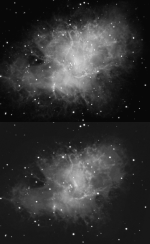 The Incredible Expanding Crab
26.12.2001
The Crab Nebula is cataloged as M1, the first on Charles Messier's famous list of things which are not comets. In fact, the Crab is now known to be a supernova remnant, an expanding cloud of debris from the explosion of a massive star.
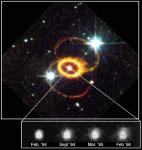 Supernova 1987a Fireball Resolved
23.01.1997
Ten years ago the most notable supernova of modern times was observed. In February 1987, light reached Earth from a star which exploded in the nearby Large Magellanic Cloud galaxy. Supernova 1987a remains the closest supernova since the invention of the telescope.
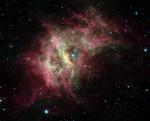 Cosmic Construction Zone RCW 49
3.06.2004
Stars and planets appear to be under construction in dusty nebula RCW 49. This Spitzer Space Telescope false-color infrared view of the nearby stellar nursery shows that known, hot stars are well on their way to clearing out the nebula's central regions.
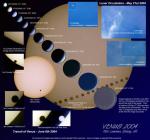 A Rare Annular Venusian Solar Eclipse
15.06.2004
An unusual type of solar eclipse occurred last week. Usually it is the Earth's Moon that eclipses the Sun. Last week, for the first time in over 100 years, the planet Venus took a turn.
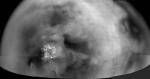 Titan Through the Haze
26.10.2004
What are these surface features on Titan? This planet-sized moon of Saturn had much of its south polar surface imaged during an initial flyby by the Saturn-orbiting Cassini spacecraft back in early July.
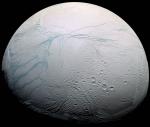 Fresh Tiger Strips on Saturns Enceladus
6.09.2005
The tiger stripes on Saturn's moon Enceladus might be active. Even today, they may be spewing ice from the moon's icy interior into space, creating a cloud of fine ice particles over the moon's South Pole and creating Saturn's mysterious E-ring.
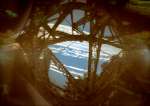 Solstice to Solstice Solargraph
26.06.2009
This six month long exposure compresses the time from solstice to solstice (~ December 21, 2008 to June 20, 2009) into a single point of view. Dubbed a solargraph, the unconventional picture was recorded with a pinhole camera made from an aluminum can lined with a piece of photographic paper.
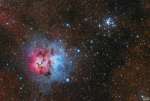 Messier 20 and 21
28.08.2014
The beautiful Trifid Nebula, also known as Messier 20, is easy to find with a small telescope in the nebula rich constellation Sagittarius. About 5,000 light-years away, the colorful study in cosmic contrasts shares this well-composed, nearly 1 degree wide field with open star cluster Messier 21 (top right).
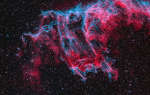 A Spectre in the Eastern Veil
29.10.2014
Frightening forms and scary faces are a mark of the Halloween season. They also haunt this cosmic close-up of the eastern Veil Nebula. The Veil Nebula itself is a large supernova remnant, the expanding debris cloud from the death explosion of a massive star.
|
January February March April May June July August September October |
|||||||||||||||||||||||||||||||||||||||||||||||||