
|
You entered: clouds
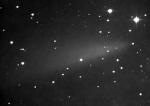 Comet LINEAR: Fade To Black
13.09.2000
Only last month the stage was set for Comet LINEAR (C/1999S4 LINEAR) to become the first "naked-eye" comet of Y2K. It didn't fill that role, of course, but it did turn in a very dramatic performance.
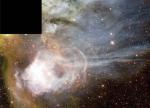 N44C: A Nebular Mystery
14.05.2002
Why is N44C glowing so strangely? The star that appears to powers the nebula, although young and bright, does not seem hot enough to create some of the colors observed. A search for a hidden hotter star in X-rays has come up empty.
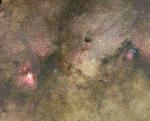 APOD: 2002 September 18- A Sagittarius Starscape
18.09.2002
Many vast star fields in the plane of our Milky Way Galaxy are rich in clouds of stars, dust, and gas. First and foremost, visible in the above picture are millions of stars, many of which are similar to our Sun.
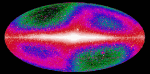 Stars in the Infrared Sky
18.09.1996
What if you could see infrared light? Because this light is less absorbed by dust than visible light, you could peer into the center of our Milky Way Galaxy. The stars there are normally hidden from direct view by the interstellar dust clouds which line the Galactic plane.
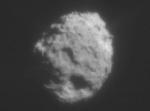 Comet Wild 2s Nucleus from Stardust
3.01.2004
What does a comet nucleus look like? Yesterday the robot spacecraft Stardust answered this question by returning the most detailed images yet of the center of a comet. The icy centers of comets are usually hidden from Earth-bound telescopes by opaque dust and gas that boils off during approach to the Sun.
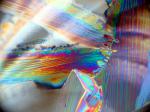 Frizion Illume
26.02.2005
Scientific images of cosmic dust clouds or even frozen water can be esthetic too. In fact, this picture of thin layers of forming ice crystals uses a scientific understanding of light's wave properties solely for artistic purposes. Titled "Illume", the picture was created by astrophysicist Peter Wasilewski.
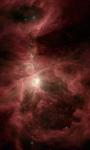 Spitzer s Orion
18.08.2006
Few cosmic vistas excite the imagination like the Orion Nebula, an immense stellar nursery some 1,500 light-years away. Also known as M42, the nebula is visible to the unaided eye, but this stunning...
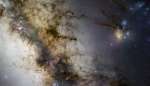 Gigagalaxy Zoom: Galactic Center
25.09.2009
From Sagittarius to Scorpius, the central Milky Way is a truly beautiful part of planet Earth's night sky. The gorgeous region is captured here, an expansive gigapixel mosaic of 52 fields spanning 34 by 20 degrees in 1200 individual images and 200 hours of exposure time.
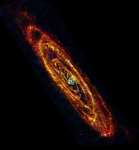 Herschel s Andromeda
2.02.2013
This infrared view from the Herschel Space Observatory explores the Andromeda Galaxy, the closest large spiral galaxy to our own Milky Way. Only 2.5 million light-years distant, the famous island universe is also known to astronomers as M31. Andromeda spans over 200,000 light-years making it more the twice the size of the Milky Way.
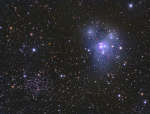 NGC 7129 and NGC 7142
30.08.2019
This wide-field telescopic image looks toward the constellation Cepheus and an intriguing visual pairing of dusty reflection nebula NGC 7129 (right) and open star cluster NGC 7142. The two appear separated by only half a degree on the sky, but they actually lie at quite different distances.
|
January February March April May June July August September October |
|||||||||||||||||||||||||||||||||||||||||||||||||