
|
You entered: clouds
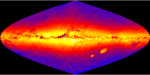 USNO A2.0 Catalog: A Digital Sky
26.04.1999
Here lie 526,230,881 of the brightest stars known. The US Naval Observatory has deployed their monster Precision Measuring Machine to digitize photographic plates covering the whole sky and creating the above map. Yellow corresponds to 150,000 stars per square degree, while dark blue corresponds to only 500 stars per square degree.
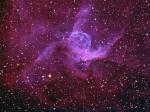 Thor s Helmet in H Alpha
2.02.2006
Near picture center, the helmet-shaped structure with wing-like appendages is popularly called Thor's Helmet. Cataloged as NGC 2359, the striking nebula is located about 15,000 light-years away in the constellation Canis Major.
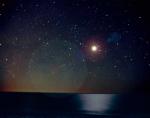 1006 AD: Supernova in the Sky
30.04.2006
A new star, likely the brightest supernova in recorded human history, appeared in planet Earth's sky about 1,000 years ago today, in 1006 AD. The expanding debris cloud from the stellar explosion is still visible to modern astronomers, but what did the supernova look like in 1006?
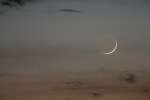 Moon Meets Mercury
9.05.2008
On Tuesday, May 6, while standing on planet Earth and sweeping your binoculars along the western horizon just after sunset, you might have encountered this arresting skyscape. The view features a slender crescent Moon and bright planet Mercury separated on the sky by only about 2 degrees.
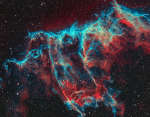 A Spectre in the Eastern Veil
1.11.2008
Menacing flying forms and garish colors are a mark of the Halloween season. They also stand out in this cosmic close-up of the eastern Veil Nebula. The Veil Nebula itself is a large supernova remnant, the expanding debris cloud from the death explosion of a massive star.
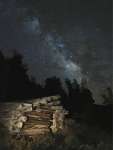 Lyrid Meteor and Milky Way
1.05.2009
On April 22nd, the Lyrid Meteor Shower visited planet Earth's sky, an annual shower produced as the Earth plows through dust from the tail of comet Thatcher. Usually Lyrid meteor watchers see only a drizzle.
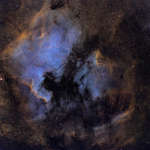 North America and the Pelican
18.12.2010
Here lie familiar shapes in unfamiliar locations. On the left is an emission nebula cataloged as NGC 7000, famous partly because it resembles our fair planet's continent of North America. The emission region to the right of the North America Nebula is IC 5070, also known for its suggestive outlines as the Pelican Nebula.
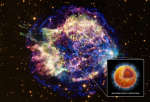 Cooling Neutron Star
5.03.2011
Supernova remnant Cassiopeia A (Cass A) is a comfortable 11,000 light-years away. Light from the Cass A supernova, the death explosion of a massive star, first reached Earth just 330 years ago.
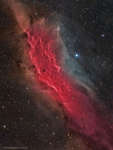 The California Nebula
12.01.2016
What's California doing in space? Drifting through the Orion Arm of the spiral Milky Way Galaxy, this cosmic cloud by chance echoes the outline of California on the west coast of the United States.
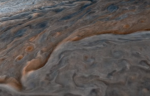 Jupiter Diving
14.12.2017
Take this simulated plunge and dive into the upper atmosphere of Jupiter, the Solar System's ruling gas giant. The awesome animation is based on image data from JunoCam, and the microwave radiometer on board the Jupiter-orbiting Juno spacecraft.
|
January February March April May June July August September October |
|||||||||||||||||||||||||||||||||||||||||||||||||