
|
You entered: ring
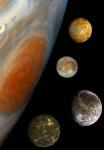 Jupiter And Family
18.11.2000
This composite image features classic portraits of members of one of the Solar System's most prominent families - Jupiter and its four large "Galilean" moons. Starting from the top the moons are Io, Europa, Ganymede, and Callisto. The top-to-bottom order is also the order of increasing distance from Jupiter.
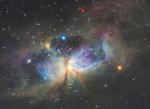 Star Forming Region S106
20.02.2001
Massive star IRS4 is beginning to spread its wings. Born only about 100,000 years ago, material streaming out from this newborn star has formed the nebula dubbed Sharpless 106 Nebula (S106), pictured above.
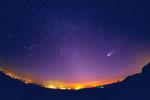 Sirius: The Brightest Star in the Night
11.06.2000
Sirius is the brightest star in the night sky. Sirius is visible on the far left of the above photograph, to the left of the constellation of Orion and Comet Hale-Bopp. Intrinsically, Sirius is over 20 times brighter than our Sun and over twice as massive.
 Chandra Deep Field
28.03.2001
Officially the Chandra Deep Field - South, this picture represents the deepest ever x-ray image of the Universe. One million seconds of accumulated exposure time with the orbiting Chandra X-ray Observatory went in to its making.
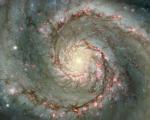 M51: The Whirlpool Galaxy in Dust and Stars
10.04.2001
The Whirlpool Galaxy is a classic spiral galaxy. At only 30 million light years distant and fully 60 thousand light years across, M51, also known as NGC 5194, is one of the brightest and most picturesque galaxies on the sky.
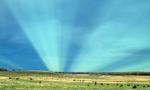 Anticrepuscular Rays Over Colorado
30.10.2001
What's happening over the horizon? Although the scene may appear somehow supernatural, nothing more unusual is occurring than a setting Sun and some well placed clouds. Pictured above are anticrepuscular rays. To understand them, start by picturing common crepuscular rays that are seen any time that sunlight pours though scattered clouds.
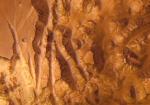 Valles Marineris from Mars Express
24.01.2004
Looking down from orbit on January 14, ESA's Mars Express spacecraft scanned a 1700 by 65 kilometer swath across Valles Marineris - the Grand Canyon of Mars - with its remarkable High Resolution Stereo Camera.
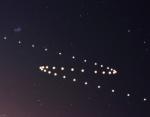 Z is for Mars
22.04.2006
This composite of images spaced about a week apart - from late July 2005 (bottom right) through February 2006 (top left) - traces the retrograde motion of ruddy-colored Mars through planet Earth's night sky. On November 7th, 2005 the Red Planet was opposite the Sun in Earth's sky (at opposition).
 Mars Polar Lander Target Ellipse
4.12.1999
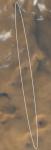
South is up in this recent composite color picture of Mars Polar Lander's target region near the Martian South Pole taken on November 28. Imaged by the orbiting Mars Global Surveyor's wide angle camera, the area covered is 105 kilometers across with the expected landing ellipse superposed.
 The Incredible Expanding Cats Eye
16.09.1999
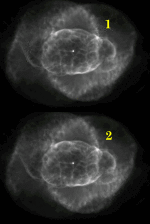
Watch closely. As this animation blinks between two Hubble Space Telescope images of NGC 6543 - the first from 1994 and the second from 1997 - the intricate filaments of this nebula are seen to shift. The shift is due to the actual expansion of this gaseous shroud shed by a dying star!
|
January February March April May June July August September October |
|||||||||||||||||||||||||||||||||||||||||||||||||