
|
You entered: ring
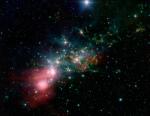 Dusty NGC 1333
24.11.2005
Dusty NGC 1333 is seen as a reflection nebula in visible light images, sporting bluish hues characteristic of starlight reflected by dust. But at longer infrared wavelengths, the interstellar dust itself glows - shown in red in this false-color Spitzer Space Telescope image.
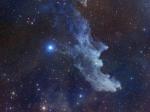 IC 2118: The Witch Head Nebula
11.12.2006
Double, double toil and trouble; Fire burn, and cauldron bubble -- maybe Macbeth should have consulted the Witch Head Nebula. This suggestively shaped reflection nebula is associated with the bright star Rigel in the constellation Orion.
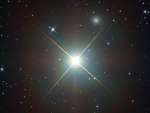 Mirach s Ghost
29.10.2008
As far as ghosts go, Mirach's Ghost isn't really that scary. In fact, Mirach's Ghost is just a faint, fuzzy galaxy, well known to astronomers, that happens to be seen nearly along the line-of-sight to Mirach, a bright star. Centered in this star field, Mirach is also called Beta Andromedae.
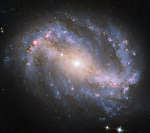 Barred Spiral Galaxy NGC 6217
28.12.2009
Many spiral galaxies have bars across their centers. Even our own Milky Way Galaxy is thought to have a modest central bar. Prominently barred spiral galaxy NGC 6217, pictured above, was captured in spectacular detail in this recently released image taken by the newly repaired Advanced Camera for Surveys on the orbiting Hubble Space Telescope.
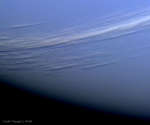 Two Hours Before Neptune
14.02.2015
Two hours before closest approach to Neptune in 1989, the Voyager 2 robot spacecraft snapped this picture. Clearly visible for the first time were long light-colored cirrus-type clouds floating high in Neptune's atmosphere. Shadows of these clouds can even be seen on lower cloud decks.
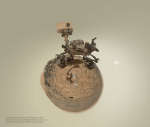 Little Planet Curiosity
22.08.2015
A curious robot almost completely straddles this rocky little planet. Of course, the planet is really Mars and the robot is the car-sized Curiosity Rover, posing over its recent drilling target in the Marias Pass area of lower Mount Sharp.
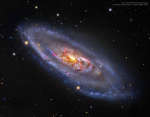 M106: A Spiral Galaxy with a Strange Center
17.03.2019
What's happening at the center of spiral galaxy M106? A swirling disk of stars and gas, M106's appearance is dominated by blue spiral arms and red dust lanes near the nucleus, as shown in the featured image.
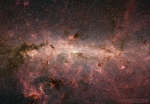 The Galactic Center in Infrared
19.04.2021
What does the center of our galaxy look like? In visible light, the Milky Way's center is hidden by clouds of obscuring dust and gas. But in this stunning vista, the Spitzer Space Telescope's infrared cameras, penetrate much of the dust revealing the stars of the crowded galactic center region.
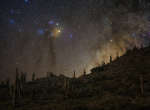 Deepscape at Yacoraite
8.05.2021
In this evocative night scene a dusty central Milky Way rises over the ancient Andean archaeological site of Yacoraite in northwestern Argentina. The denizens of planet Earth reaching skyward are the large Argentine saguaro cactus currently native to the arid region.
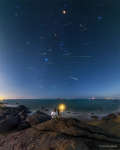 Leonid Meteors Through Orion
28.11.2022
Where will the next meteor appear? Even during a meteor shower, it is practically impossible to know. Therefore, a good way to enjoy a meteor shower is to find a place where you can sit comfortably and monitor a great expanse of dark sky.
|
January February March April May June July August September October |
|||||||||||||||||||||||||||||||||||||||||||||||||