
|
You entered: ring
 APOD: 2023 March 14 Б W5: The Soul Nebula
14.03.2023
Stars are forming in the Soul of the Queen of Aethopia. More specifically, a large star forming region called the Soul Nebula can be found in the direction of the constellation Cassiopeia, whom Greek mythology credits as the vain wife of a King who long ago ruled lands surrounding the upper Nile river.
 APOD: 2023 May 17 Б Sunspot with Light Bridge
17.05.2023
Why would a small part of the Sun appear slightly dark? Visible is a close-up picture of sunspots, depressions on the Sun's surface that are slightly cooler and less bright than the rest of the Sun. The Sun's complex magnetic field creates these cool regions by inhibiting hot material from entering the spots.
 APOD: 2024 August 19 Б IC 5146: The Cocoon Nebula
19.08.2024
Inside the Cocoon Nebula is a newly developing cluster of stars. Cataloged as IC 5146, the beautiful nebula is nearly 15 light-years wide. Soaring high in northern summer night skies, it's located some 4,000 light years away toward the constellation of the Swan (Cygnus).
 NGC 6302: The Butterfly Nebula
6.06.2025
The bright clusters and nebulae of planet Earth's night sky are often given the names of flowers or insects, and its whopping 3 light-year wingspan, NGC 6302 is no exception. With an estimated...
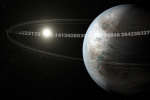 APOD: 2026 March 14 Б A Year for K2-315b
14.03.2026
Want to visit a planet that has 3.14 days in a year? Then plan a trip to K2-315b, an earth-sized planet orbiting around a cool, red, M dwarf star about once every 3.14 days.
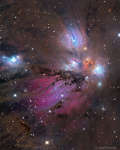 APOD: 2026 May 19 Б NGC 2170: The Angel Nebula
19.05.2026
Is this a painting or a photograph? In this celestial abstract art composed with a cosmic brush, dusty nebula NGC 2170, also known as the Angel Nebula, shines just above the image center. Reflecting...
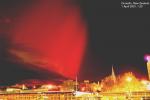 Aurora Over New Zealand
6.04.2001
Last weekend skygazers at middle and high latitudes around the globe were treated to expansive auroral displays as a magnetic storm raged around planet Earth. The storm was triggered by a solar coronal mass ejection associated with the giant sunspot group cataloged as active region number 9393.
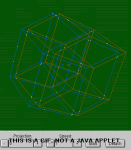 A Higher Dimensional Universe
18.04.2001
Does our universe have higher but unusual spatial dimensions? This idea has been gaining popularity to help explain why vastly separated parts of our universe appear so similar, and why the geometry of our universe does not seem to result naturally from the amounts of matter it
 Opportunity Rover Indicates Ancient Mars Was Wet
3.03.2004
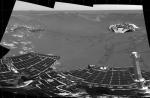
Was Mars ever wet enough to support life? To help answer this question, NASA launched two rover missions to the red planet and landed them in regions that satellite images indicated might have been covered with water.
 A Full Sky Multi Colored Auroral Corona
9.11.2004
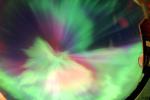
On some nights the sky is the most interesting show in town. This fisheye picture captures a particularly active and colorful auroral corona that occurred two days ago over l'Observatoire de la Decouverte in Val Belair near Quebec, Canada.
|
January February March April May June July August September October |
|||||||||||||||||||||||||||||||||||||||||||||||||