
|
You entered: image
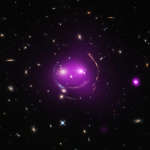 Gravity s Grin
26.10.2019
Albert Einstein's general theory of relativity, published over 100 years ago, predicted the phenomenon of gravitational lensing. And that's what gives these distant galaxies such a whimsical appearance, seen through the looking glass of X-ray and optical image data from the Chandra and Hubble space telescopes.
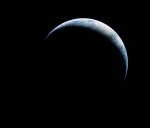 Apollo 17: The Crescent Earth
29.04.2021
Our fair planet sports a curved, sunlit crescent against the black backdrop of space in this stunning photograph. From the unfamiliar perspective, the Earth is small and, like a telescopic image of a distant planet, the entire horizon is completely within the field of view.
 Satellites Behind Pinnacles
14.06.2022
What are all those streaks across the background? Satellite trails. First, the foreground features picturesque rock mounds known as Pinnacles. Found in the Nambung National Park in Western Australia, these human-sized spires are made by unknown processes from ancient sea shells (limestone). Perhaps more eye-catching, though, is the sky behind.
 APOD: 2023 July 9 Б Doomed Star Eta Carinae
9.07.2023
Eta Carinae may be about to explode. But no one knows when - it may be next year, it may be one million years from now. Eta Carinae's mass - about 100 times greater than our Sun - makes it an excellent candidate for a full blown supernova.
 APOD: 2024 September 9 Б Mars: Moon, Craters, and Volcanos
9.09.2024
If you could fly over Mars, what might you see? The featured image shows exactly this in the form of a Mars Express vista captured over a particularly interesting region on Mars in July. The picture's most famous feature is Olympus Mons, the largest volcano in the Solar System, visible on the upper right.
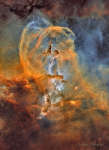 APOD: 2026 July 20 Б NGC 3576: The Statue of Liberty Nebula
20.07.2026
What's happening in the Statue of Liberty nebula? Bright stars and interesting molecules are forming and being liberated. The complex nebula resides in the star forming region called RCW 57, and besides the iconic monument, to some looks like a flying superhero or a weeping angel.
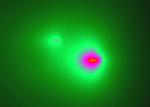 Another Comet LINEAR Breaks Up
21.05.2001
Last year, a different comet LINEAR (C/1999 S4) broke up. This year, a comet first imaged by the Lincoln Near Asteroid Research (LINEAR) telescope in New Mexico on 2001 January 3, is also breaking up.
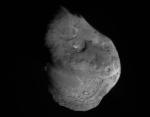 The Nucleus of Comet Tempel 1
15.09.2005
Approaching the nucleus of comet Tempel 1 at ten kilometers per second, the Deep Impact probe's targeting camera recorded a truly dramatic series of images. Successive pictures improve in resolution and have been...
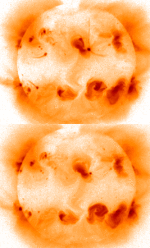 X Ray Triple Jet
31.07.1999
Recorded on July 7, 1998, this animation using X-ray images of the Sun shows an amazing event - three nearly simultaneous jets connected with solar active regions. The two frames were taken several hours apart by the Soft X-ray Telescope on board the orbiting Yohkoh observatory.
 Planetary Nebula NGC 2440
15.02.2007
Planetary nebula NGC 2440 has an intriguing bow-tie shape in this stunning view from space. The nebula is composed of material cast off by a dying sun-like star as it enters its white dwarf phase of evolution.
|
January February March April May June July August September |
|||||||||||||||||||||||||||||||||||||||||||||||||