
|
You entered: image
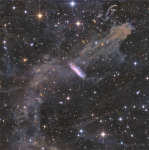 A Galaxy Beyond Stars, Gas, Dust
19.10.2022
Do we dare believe our eyes? When we look at images of space, we often wonder whether they are "real", and just as often the best answer varies. In this case, the scene appears...
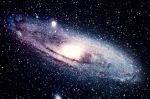 M31: The Andromeda Galaxy
24.07.1995
Andromeda is the nearest major galaxy to our own Milky Way Galaxy. Our Galaxy is thought to look much like Andromeda. Together these two galaxies dominate the Local Group of galaxies. The diffuse light from Andromeda is caused by the hundreds of billions of stars that compose it.
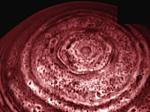 A Mysterious Hexagonal Cloud System on Saturn
3.04.2007
Why would clouds form a hexagon on Saturn? Nobody is yet sure. Originally discovered during the Voyager flybys of Saturn in the 1980s, nobody has ever seen anything like it anywhere else in the Solar System.
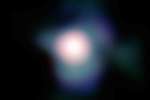 Betelgeuse Resolved
5.08.2009
The sharpest image ever of Betelgeuse shows a mammoth star that is slowly evaporating. Betelgeuse (sounds a lot like "beetle juice"), also known as Alpha Orionis, is one of the largest and brightest stars known. The star is a familiar orange fixture easily visible to the unaided eye toward the constellation of Orion.
 The Solar System from MESSENGER
23.02.2011
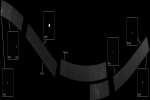
If you looked out from the center of the Solar System, what would you see? Nearly such a view was taken recently from the MESSENGER spacecraft currently orbiting the Sun from the distance of Mercury. The Sun's planets all appear as points of light, with the closest and largest planets appearing the brightest.
 APOD Turns 17
16.06.2012
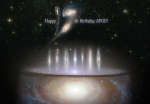
The first APOD appeared seventeen years ago today, on 1995 June 16. Although garnering only 14 page views on that day, we are proud to estimate that APOD has now served over one billion space-related images over the last 1.7 decades.
 Gravity s Grin
27.11.2015
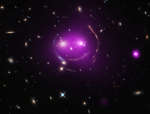
Albert Einstein's general theory of relativity, published 100 years ago this month, predicted the phenomenon of gravitational lensing. And that's what gives these distant galaxies such a whimsical appearance, seen through the looking glass of X-ray and optical image data from the Chandra and Hubble space telescopes.
 NGC 602 and Beyond
2.04.2017
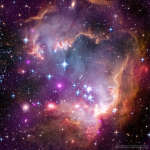
Near the outskirts of the Small Magellanic Cloud, a satellite galaxy some 200 thousand light-years distant, lies 5 million year young star cluster NGC 602. Surrounded by natal gas and dust...
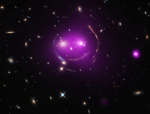 Gravity s Grin
5.08.2017
Albert Einstein's general theory of relativity, published over 100 years ago, predicted the phenomenon of gravitational lensing. And that's what gives these distant galaxies such a whimsical appearance, seen through the looking glass of X-ray and optical image data from the Chandra and Hubble space telescopes.
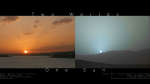 APOD: 2020 August 2 Б Two Worlds One Sun
2.08.2020
How different does sunset appear from Mars than from Earth? For comparison, two images of our common star were taken at sunset, one from Earth and one from Mars. These images were scaled to have same angular width and featured here side-by-side.
|
January February March April May June July August September |
|||||||||||||||||||||||||||||||||||||||||||||||||