
|
You entered: constellation
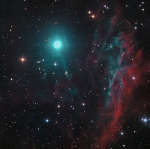 The Ghost of Jupiter s Halo
11.07.2019
Close-up images of NGC 3242 show the cast off shroud of a dying, sun-like star fancifully known as The Ghost of Jupiter nebula. But this deep and wide telescopic view also finds the seldom...
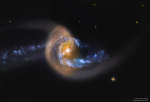 NGC 7714: Starburst after Galaxy Collision
9.10.2019
Is this galaxy jumping through a giant ring of stars? Probably not. Although the precise dynamics behind the featured image is yet unclear, what is clear is that the pictured galaxy, NGC 7714, has been stretched and distorted by a recent collision with a neighboring galaxy.
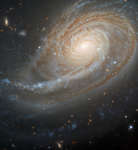 Arp 78: Peculiar Galaxy in Aries
24.03.2022
Peculiar spiral galaxy Arp 78 is found within the boundaries of the head strong constellation Aries. Some 100 million light-years beyond the stars and nebulae of our Milky Way galaxy, the island universe is over 100,000 light-years across.
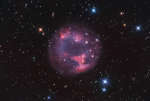 Planetary Nebula Abell 7
21.05.2022
Very faint planetary nebula Abell 7 is some 1,800 light-years distant, just south of Orion in planet Earth's skies in the constellation Lepus, The Hare. Surrounded by Milky Way stars and near...
 A View Toward M106
22.02.2024
Big, bright, beautiful spiral, Messier 106 dominates this cosmic vista. The nearly two degree wide telescopic field of view looks toward the well-trained constellation Canes Venatici, near the handle of the Big Dipper. Also...
 A Beautiful Trifid
4.07.2024
The beautiful Trifid Nebula is a cosmic study in contrasts. Also known as M20, it lies about 5,000 light-years away toward the nebula rich constellation Sagittarius. A star forming region in the plane...
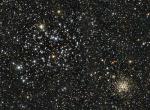 Open Star Clusters M35 and NGC 2158
29.11.2002
Open clusters of stars can be near or far, young or old, and diffuse or compact. Open clusters may contain from 100 to 10,000 stars, all of which formed at nearly the same time. Bright blue stars frequently distinguish younger open clusters.
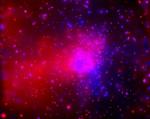 X Rays from M17
21.08.2003
About 5,000 light-years away, toward the constellation Sagittarius and the center of our galaxy, lies the bright star forming region cataloged as M17. In visible light, M17's bowed and hollowed-out appearance has resulted in many popular names like the Horseshoe, Swan, Omega, and Lobster nebula. But what has sculpted this glowing gas cloud?
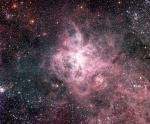 The Tarantula Zone
23.08.2003
The Tarantula Nebula is more than 1,000 light-years across - a giant emission nebula within our neighboring galaxy the Large Magellanic Cloud. Inside this cosmic arachnid lies a central young cluster of massive stars, cataloged as R136, whose intense radiation and strong winds have helped energize the nebular glow and shape the spidery filaments.
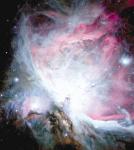 The Orion Nebula from CFHT
15.03.2004
Few astronomical sights excite the imagination like the nearby stellar nursery known as the Orion Nebula. The Nebula's glowing gas surrounds hot young stars at the edge of an immense interstellar molecular cloud only 1500 light-years away.
|
January February March April May June July August September October |
|||||||||||||||||||||||||||||||||||||||||||||||||