
|
You entered: gas
 A MACHO View of Galactic Dark Matter
2.02.1996
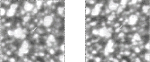
What is our Galaxy made of? Stellar motions indicate there is much more mass than just stars and gas. Photographs like the two shown above may be yielding a clue about the dark matter, however.
 Twin Proto Planetary Disks
25.09.1998
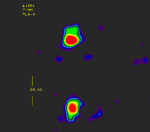
Sun-like stars are forming - and probably planets too - hidden inside Lynds 1551, an interstellar cloud of molecular gas and dust in the constellation Taurus. Using new receivers, coordinated radio telescopes at the Very Large Array near Socorro, New Mexico, USA, can now sharply image the dusty proto-planetary disks surrounding these young stars at radio wavelengths.
 Jupiter, Vesta, and the Milky Way
25.05.2007
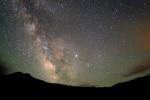
In this gorgeous skyscape, gas giant Jupiter along with the stars and cosmic dust clouds of the Milky Way hang over the southern horizon in the early morning hours as seen from Stagecoach, Colorado, USA. Recorded on Thursday, Jupiter is the brightest object near picture center.
 The Center of Centaurus A
29.07.2007
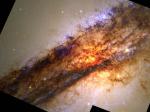
A fantastic jumble of young blue star clusters, gigantic glowing gas clouds, and imposing dark dust lanes surrounds the central region of the active galaxy Centaurus A. This mosaic of Hubble Space Telescope images taken in blue, green, and red light has been processed to present a natural color picture of this cosmic maelstrom.
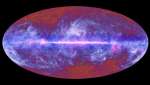 Microwave Milky Way
9.07.2010
Seen from our edge-on perspective, the Milky Way Galaxy sprawls across the middle of this false-color, all sky view. The expansive microwave map is based on 1 year's worth of data from instruments onboard the sky-surveying Planck spacecraft.
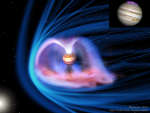 Auroras and the Magnetosphere of Jupiter
6.04.2016
Jupiter has auroras. Like near the Earth, the magnetic field of our Solar System's largest planet compresses when impacted by a gust of charged particles from the Sun. This magnetic compression funnels charged particles towards Jupiter's poles and down into the atmosphere.
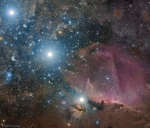 Orion: Belt, Flame, and Horsehead
4.06.2017
What surrounds the famous belt stars of Orion? A deep exposure shows everything from dark nebula to star clusters, all embedded in an extended patch of gaseous wisps in the greater Orion Molecular Cloud Complex.
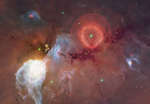 Massive Shell Expelling Star G79 29 0 46
25.09.2017
Stars this volatile are quite rare. Captured in the midst of dust clouds and visible to the right and above center is massive G79.29+0.46, one of less than 100 luminous blue variable stars (LBVs) currently known in our Galaxy.
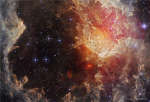 NGC 7822: Stars and Dust Pillars in Infrared
19.11.2017
Young stars themselves are clearing out their nursery in NGC 7822. Within the nebula, bright edges and complex dust sculptures dominate this detailed skyscape taken in infrared light by NASA's Wide Field Infrared Survey Explorer (WISE) satellite.
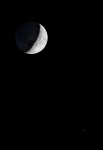 Jupiter and the Moons
5.10.2019
After sunset on October 3, some of the Solar System's largest moons stood low along the western horizon with the largest planet. Just after nightfall, a pairing of the Moon approaching first quarter phase and Jupiter was captured in this telephoto field of view.
|
January February March April May June July August September October |
|||||||||||||||||||||||||||||||||||||||||||||||||