
|
You entered: gas
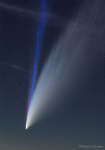 Three Tails of Comet NEOWISE
8.03.2021
What created the unusual red tail in Comet NEOWISE? Sodium. A spectacular sight back in the summer of 2020, Comet NEOWISE, at times, displayed something more than just a surprisingly striated white dust tail and a pleasingly patchy blue ion tail.
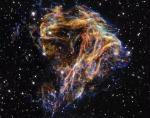 N49 s Cosmic Blast
4.07.2003
Scattered debris from a cosmic supernova explosion lights up the sky in this gorgeous composited image based on data from the Hubble Space Telescope. Cataloged as N49, these glowing filaments of shocked gas span about 30 light-years in our neighboring galaxy, the Large Magellanic Cloud.
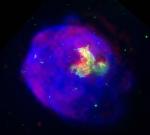 Structure in N63A
1.01.2004
Shells and arcs abound in this false-color, multiwavelength view of supernova remnant N63A, the debris of a massive stellar explosion. The x-ray emission (blue), is from gas heated to 10 million degrees C as knots of fast moving material from the cosmic blast sweep up surrounding interstellar matter.
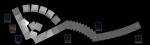 Solar System Portrait
14.02.2004
On another Valentine's Day (February 14, 1990), cruising four billion miles from the Sun, the Voyager 1 spacecraft looked back to make this first ever family portrait of our Solar System. The complete portrait is a 60 frame mosaic made from a vantage point 32 degrees above the ecliptic plane.
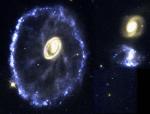 Cartwheel Of Fortune
19.12.1998
By chance, a collision of two galaxies has created a surprisingly recognizable shape on a cosmic scale - "The Cartwheel Galaxy". The Cartwheel is part of a group of galaxies about 500 million light years away in the constellation Sculptor (two smaller galaxies in the group are visible on the right).
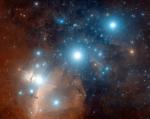 Alnitak, Alnilam, Mintaka
13.10.2005
Alnitak, Alnilam, and Mintaka, are the bright bluish stars from east to west (left to right) along the diagonal in this gorgeous cosmic vista. Otherwise known as the Belt of Orion, these three blue supergiant stars are hotter and much more massive than the Sun.
 Alnitak, Alnilam, Mintaka
29.12.2006
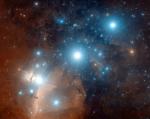
Alnitak, Alnilam, and Mintaka, are the bright bluish stars from east to west (left to right) along the diagonal in this gorgeous cosmic vista. Otherwise known as the Belt of Orion, these three blue supergiant stars are hotter and much more massive than the Sun.
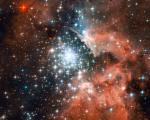 Starburst Cluster in NGC 3603
5.10.2007
A mere 20,000 light-years from the Sun lies NGC 3603, a resident of the nearby Carina spiral arm of our Milky Way Galaxy. NGC 3603 is well known to astronomers as one of the Milky Way's largest star-forming regions.
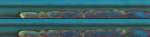 Saturn Storm Panoramas
8.07.2011
These tantalizing panoramas follow a remarkable giant storm encircling the northern hemisphere of ringed planet Saturn. Still active, the roiling storm clouds were captured in near-infrared images recorded by the Cassini spacecraft on February 26 and stitched into the high resolution, false-color mosaics.
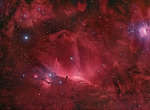 Wisps Surrounding the Horsehead Nebula
9.09.2012
The famous Horsehead Nebula in Orion is not alone. A deep exposure shows that the dark familiar shaped indentation, visible just below center, is part of a vast complex of absorbing dust and glowing gas.
|
January February March April May June July August September October |
|||||||||||||||||||||||||||||||||||||||||||||||||