
|
You entered: galaxies
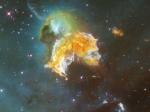 Rampaging Supernova Remnant N63A
8.06.2005
What has this supernova left behind? As little as 2,000 years ago, light from a massive stellar explosion in the Large Magellanic Clouds (LMC) first reached planet Earth. The LMC is a close...
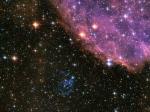 Supernova Remnant E0102 from Hubble
29.08.2006
It's the blue wisp near the bottom that's the remnant of a tremendous recent supernova explosion. The large pink structure looming to the upper right is part of N76, a large star forming region in our neighboring Small Magellanic Cloud (SMC) galaxy. The supernova remnant wisp, with full coordinate name 1E0102.
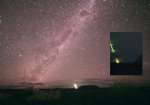 Fireball at Ayers Rock
28.06.2008
A weekend trip for astrophotography in central Australia can result in gorgeous skyscapes. In this example recorded in March of 2006, the center of our Milky Way Galaxy rises over planet Earth's horizon and the large sandstone formation called Uluru, also known as Ayers Rock.
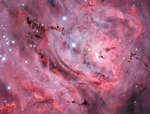 The Deep Lagoon
29.07.2015
Ridges of glowing interstellar gas and dark dust clouds inhabit the turbulent, cosmic depths of the Lagoon Nebula. Also known as M8, The bright star forming region is about 5,000 light-years distant.
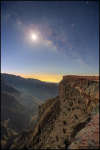 Milky Way in Moonlight
23.04.2016
A waning crescent moon, early morning twilight, and Al Hamra's city lights on the horizon can't hide the central Milky Way in this skyscape from planet Earth. Captured in a single exposure...
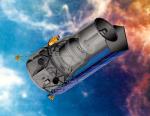 SIRTF: Name This Satellite
19.09.2001
NASA is preparing to launch its next Great Observatory in 2002, but it does not yet have a proper name. Can you help? Currently referred to only as the Space Infrared Telescope Facility (SIRTF), NASA seeks to add something more significant.
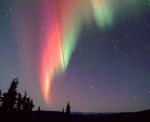 Comet and Aurora Over Alaska
22.04.2002
Can you spot the comet? Flowing across the frozen Alaskan landscape is an easily visible, colorful aurora. Just to the lower left, however, well in the background, is something harder to spot: Comet Ikeya-Zhang, the brightest comet of recent years. Although the aurora faded in minutes, the comet is just now beginning to fade.
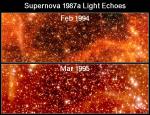 Moving Echoes Around SN 1987A
24.10.1997
Yesterday's image highlighted reflective rings of light emitted by a supernova explosion. Today's pictures, taken over a year apart, highlight how these echoes are seen to move over time. Visible...
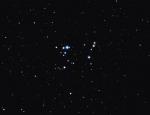 The 37 Cluster
18.11.2005
For the mostly harmless denizens of planet Earth, the brighter stars of open cluster NGC 2169 seem to form a cosmic 37. (Did you expect 42?.) Of course, the improbable numerical asterism appears solely by chance and lies at an estimated distance of 3,600 light-years toward the constellation Orion.
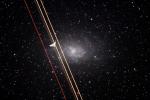 Just Passing Through
25.08.2007
M33 is a big, beautiful spiral galaxy a mere 3 million light-years away, understandably a popular target for enthusiastic astro-imagers. Just as understandably, interfering satellite trails and airplane streaks that are becoming more common in planet Earth's busy night sky are processed out of their finished images.
|
January February March April May June July August September October |
|||||||||||||||||||||||||||||||||||||||||||||||||